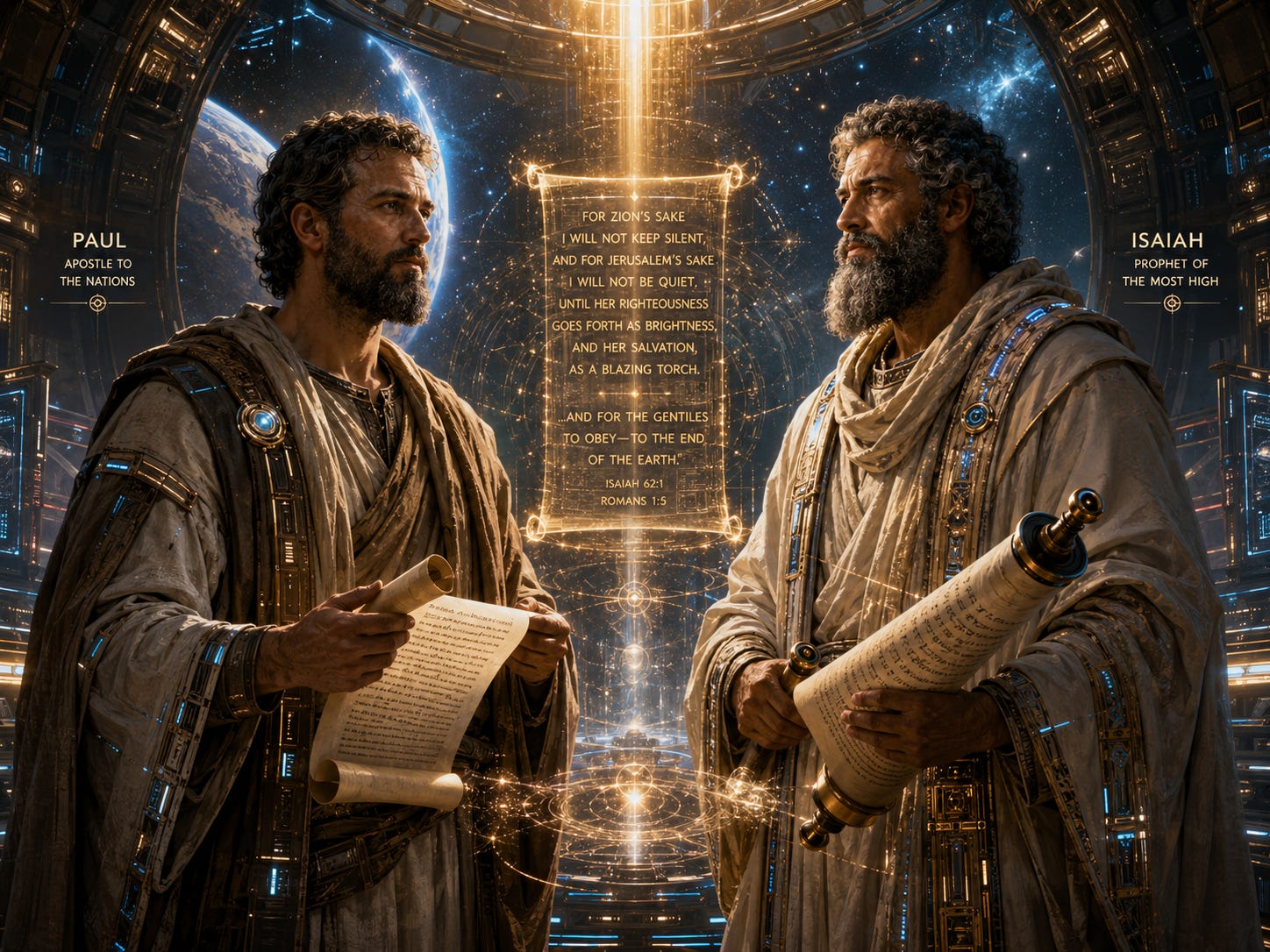
The Direct Relationship Between Romans and Isaiah
“For whatever was written in earlier times was written for our instruction, so that through perseverance and the encouragement of the Scriptures we might have hope.” — Romans 15:4 (NASB)

Overview
Paul’s letter to the Romans is the most theologically dense epistle in the New Testament, and no Old Testament book is quoted more extensively within it than Isaiah. Of the approximately 60 Old Testament quotations in Romans, roughly 20 come directly from Isaiah — more than any other single prophetic book. This is not coincidental. Paul saw Isaiah as the prophetic backbone for the gospel of grace, the inclusion of the Gentiles, and the sovereignty of God in salvation.
Thematic Parallels at a Glance
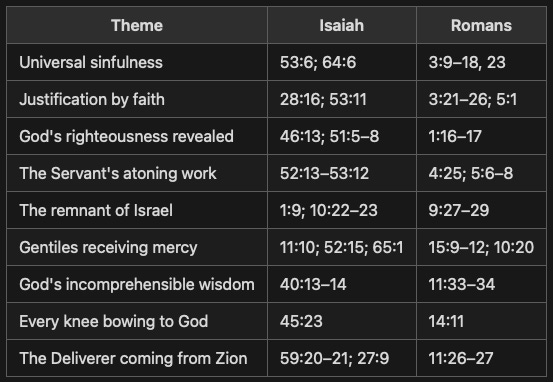
Direct Quotations: Romans ↔ Isaiah
1. Romans 1:17 ← Habakkuk 2:4 / Isaiah 26:2
“The righteous shall live by faith.”
While the direct quotation is from Habakkuk, Paul’s entire argument in Romans 1–4 echoes Isaiah’s proclamation that God’s righteousness is being revealed (Isa. 46:13; 51:5–8) — not through law-keeping, but through covenant faithfulness.
2. Romans 2:24 ← Isaiah 52:5
Isaiah: “My name continually is blasphemed all day long.” Romans: “The name of God is blasphemed among the Gentiles because of you.”
Paul applies Isaiah’s indictment of Israel in exile — where God’s name was mocked by the nations because of Israel’s sin — directly to the Jews of his own day who boasted in the Law while transgressing it.
3. Romans 3:10–18 ← Isaiah 59:7–8
Isaiah 59:7–8: “Their feet run to evil, and they hasten to shed innocent blood... The way of peace they do not know.” Romans 3:15–17: “Their feet are swift to shed blood; destruction and misery are in their paths, and the path of peace they have not known.”
Paul’s great catena (chain) of Old Testament quotations proving universal sinfulness draws heavily from Isaiah 59. This passage in Isaiah depicts a society saturated in injustice — exactly the human condition Paul is arguing applies to all mankind, both Jew and Gentile.
4. Romans 4:3 / Romans 9–10 ← Isaiah 28:16
Isaiah 28:16: “Behold, I am laying in Zion a stone, a tested stone, a precious cornerstone for the foundation... he who believes will not be disturbed.” Romans 9:33: “...a stone of stumbling and a rock of offense, and he who believes in Him will not be disappointed.” Romans 10:11: “Whoever believes in Him will not be disappointed.”
Paul quotes this cornerstone passage twice in Romans. For Isaiah, the “tested stone” was God’s sure foundation against the false security of political alliances. For Paul, the Stone is Yeshua HaMashiach himself — both the stumbling block to unbelieving Israel (Isa. 8:14 combined) and the sure foundation for all who believe.
5. Romans 9:27–28 ← Isaiah 10:22–23
Isaiah: “For though your people, O Israel, be like the sand of the sea, only a remnant within them will return; a destruction is determined, overflowing with righteousness.” Romans: “Though the number of the sons of Israel be like the sand of the sea, only a remnant will be saved.”
Paul uses Isaiah’s “remnant theology” to answer the crisis: Has God’s word failed regarding Israel? (Rom. 9:6). The answer is no — God always works through a faithful remnant. The doctrine of election in Romans 9 is intelligible only against the backdrop of Isaiah’s remnant theme.
6. Romans 9:29 ← Isaiah 1:9
Isaiah: “Unless the Lord of hosts had left us a few survivors, we would be like Sodom, we would be like Gomorrah.” Romans: “Unless the Lord of Sabaoth had left to us a posterity, we would have become like Sodom, and would have resembled Gomorrah.”
Paul quotes the very opening chapter of Isaiah. The same grace that preserved a remnant from complete obliteration in Isaiah’s day is the same grace sustaining a believing remnant among ethnic Israel in Paul’s day.
7. Romans 10:15 ← Isaiah 52:7
Isaiah: “How lovely on the mountains are the feet of him who brings good news, who announces peace and brings good news of happiness...” Romans: “How beautiful are the feet of those who bring good news of good things!”
Isaiah 52 announces the end of Babylon’s exile and the return of God’s glory to Zion. Paul boldly applies this to gospel preachers sent to all nations. The new exodus is not geographical — it is spiritual. The herald announcing “Your God reigns!” is now every preacher of the gospel.
8. Romans 10:16 ← Isaiah 53:1
Isaiah: “Who has believed our message? And to whom has the arm of the Lord been revealed?” Romans: “Lord, who has believed our report?”
Paul quotes the opening line of the greatest prophetic chapter on the Suffering Servant. Isaiah 53 is the epicenter of Paul’s theology of atonement. The very lament of Isaiah — who will believe this? — becomes Paul’s explanation for why Israel’s hardness is not a surprise. The pattern of rejection was embedded in the prophecy itself.
9. Romans 10:20–21 ← Isaiah 65:1–2
Isaiah 65:1: “I permitted Myself to be sought by those who did not ask for Me; I permitted Myself to be found by those who did not seek Me.” Isaiah 65:2: “I have spread out My hands all day long to a rebellious people...” Romans 10:20–21: Paul quotes both verses — verse 1 applied to the Gentiles, verse 2 applied to Israel.
This is one of Paul’s most stunning exegetical moves. He splits a single continuous Isaiah passage and applies each half to a different audience. Gentiles, who were not seeking God, found Him. Israel, to whom God extended His hands all day, remained disobedient. Grace flows to the unexpected recipient.
10. Romans 11:8 ← Isaiah 29:10
Isaiah: “For the Lord has poured over you a spirit of deep sleep, he has shut your eyes...” Romans: “God gave them a spirit of stupor, eyes to see not and ears to hear not, down to this very day.”
Isaiah’s word to a Jerusalem that could not grasp what God was doing is applied to first-century Israel that missed its Messiah. The blindness is judicial — God’s response to persistent refusal — but it is also purposeful, as Romans 11 will go on to show.
11. Romans 11:26–27 ← Isaiah 59:20–21 + Isaiah 27:9
Isaiah 59:20–21: “A Redeemer will come to Zion, and to those who turn from transgression in Jacob... My Spirit which is upon you...” Romans 11:26–27: “The Deliverer will come from Zion, He will remove ungodliness from Jacob. This is My covenant with them, when I take away their sins.”
Paul’s great doxological climax to the “mystery” of Israel’s salvation (Rom. 11:25–27) is drawn directly from Isaiah’s vision of eschatological redemption. The coming of the Deliverer and the new covenant of Spirit are Isaiah’s promises — Paul declares they will be fulfilled for “all Israel.”
12. Romans 11:34 ← Isaiah 40:13
Isaiah: “Who has directed the Spirit of the Lord, or as His counselor has informed Him?” Romans: “For who has known the mind of the Lord, or who became His counselor?”
Isaiah 40 — the great comfort chapter, the beginning of “Deutero-Isaiah” — proclaims the incomparable majesty of God who needed no advisor. Paul closes his three-chapter meditation on God’s sovereignty in salvation (Romans 9–11) with this same doxology. God’s ways are unsearchable (Isa. 40), and His purposes in election are beyond human comprehension.
13. Romans 14:11 ← Isaiah 45:23
Isaiah: “I have sworn by Myself, the word has gone forth from My mouth in righteousness and will not turn back, that to Me every knee will bow, every tongue will swear allegiance.” Romans: “As I live, says the Lord, every knee shall bow to Me, and every tongue shall give praise to God.”
Isaiah 45:23 is the great monotheistic assertion — Yahweh alone is God, and all creation will one day acknowledge it. Paul applies this to the judgment seat of Christ (Rom. 14:10). Every believer will give an account to the one before whom every knee bows. Remarkably, Philippians 2:10–11 applies this same Isaiah text to Yeshua HaMashiach — the most direct New Testament identification of Jesus with Yahweh.
14. Romans 15:12 ← Isaiah 11:10
Isaiah: “Then in that day the nations will resort to the root of Jesse, who will stand as a signal for the peoples; and His resting place will be glorious.” Romans: “There shall come the root of Jesse, and He who arises to rule over the Gentiles, in Him shall the Gentiles hope.”
Paul’s capstone quotation in his catena on Gentile inclusion (Rom. 15:9–12) is Isaiah’s vision of the Messianic king from the line of David. The “root of Jesse” was always intended to be a banner for all nations, not for Israel only. Paul’s Gentile mission is not an afterthought — it is the fulfillment of Isaiah’s global vision.
15. Romans 15:21 ← Isaiah 52:15
Isaiah: “...those who had not been told them will see, and those who had not heard will understand.” Romans: “They who had no news of Him shall see, and they who have not heard shall understand.”
Paul closes his missionary theology by quoting Isaiah 52:15 — the very context of the Suffering Servant — as the driving motivation for his ambition to preach where Christ has not been named. The Servant’s work was always for those who had not heard. Paul sees himself as extending that Servant mission to the ends of the earth.
The Deep Structural Connection
Isaiah’s “New Exodus” and Paul’s Gospel
Isaiah’s greatest theme — the new exodus — is the deep river beneath all of Romans. Just as God redeemed Israel from Egyptian slavery, Isaiah prophesied a greater redemption from the slavery of sin and exile (Isa. 40–55). Paul’s gospel in Romans is precisely this: humanity enslaved to sin (Rom. 1–3) is redeemed through the atoning Servant (Rom. 3–5) and walks in the new life of the Spirit (Rom. 6–8).
The Servant of Isaiah 53 and Christ’s Atonement in Romans
Isaiah 53 is the silent but ever-present foundation of Romans 3–5. Paul never quotes it directly in the doctrinal section, but his language is saturated with it:
“While we were still sinners, Christ died for us” (Rom. 5:8) ← Isa. 53:12 (“He poured out Himself to death... He bore the sin of many”)
“He who was delivered over because of our transgressions” (Rom. 4:25) ← Isa. 53:5 (“He was pierced through for our transgressions”)
“By His obedience the many will be made righteous” (Rom. 5:19) ← Isa. 53:11 (“By His knowledge the Righteous One... will justify the many”)
The “Righteousness of God”
The phrase “righteousness of God” (Rom. 1:17; 3:21–22) echoes Isaiah’s repeated proclamation of God’s covenant righteousness (Isa. 46:13; 51:5, 6, 8; 56:1). For both Isaiah and Paul, God’s righteousness is not punitive condemnation but saving activity — the faithfulness of God to His covenant promises.
Summary
Isaiah is not simply a source of proof-texts for Paul — it is the prophetic architecture upon which Romans is built:
Isaiah 1–39 provides the diagnosis: sin, judgment, and the promise of a faithful remnant.
Isaiah 40–55 provides the solution: the sovereign God, the Suffering Servant, and justification.
Isaiah 56–66 provides the vision: Gentiles included, Israel restored, all creation renewed.
Romans follows the same movement:
Romans 1–3: Universal condemnation (Isa. 59; 53:6)
Romans 3–5: Justification through the Servant’s work (Isa. 52–53; 28:16)
Romans 9–11: God’s faithfulness to Israel and the Gentiles (Isa. 10; 40; 45; 65)
Romans 15: The global mission rooted in Isaiah’s vision (Isa. 11; 52; 65)
Paul read Isaiah and saw the gospel of Yeshua HaMashiach on every page.
“For I will not presume to speak of anything except what Christ has accomplished through me, resulting in the obedience of the Gentiles...” — Romans 15:18 (NASB)