
Numbers 8:1–4 — The Menorah, the Light, and the Spirit Who Sustains It
A Deep Study Across the Tanakh and the Renewed Covenant

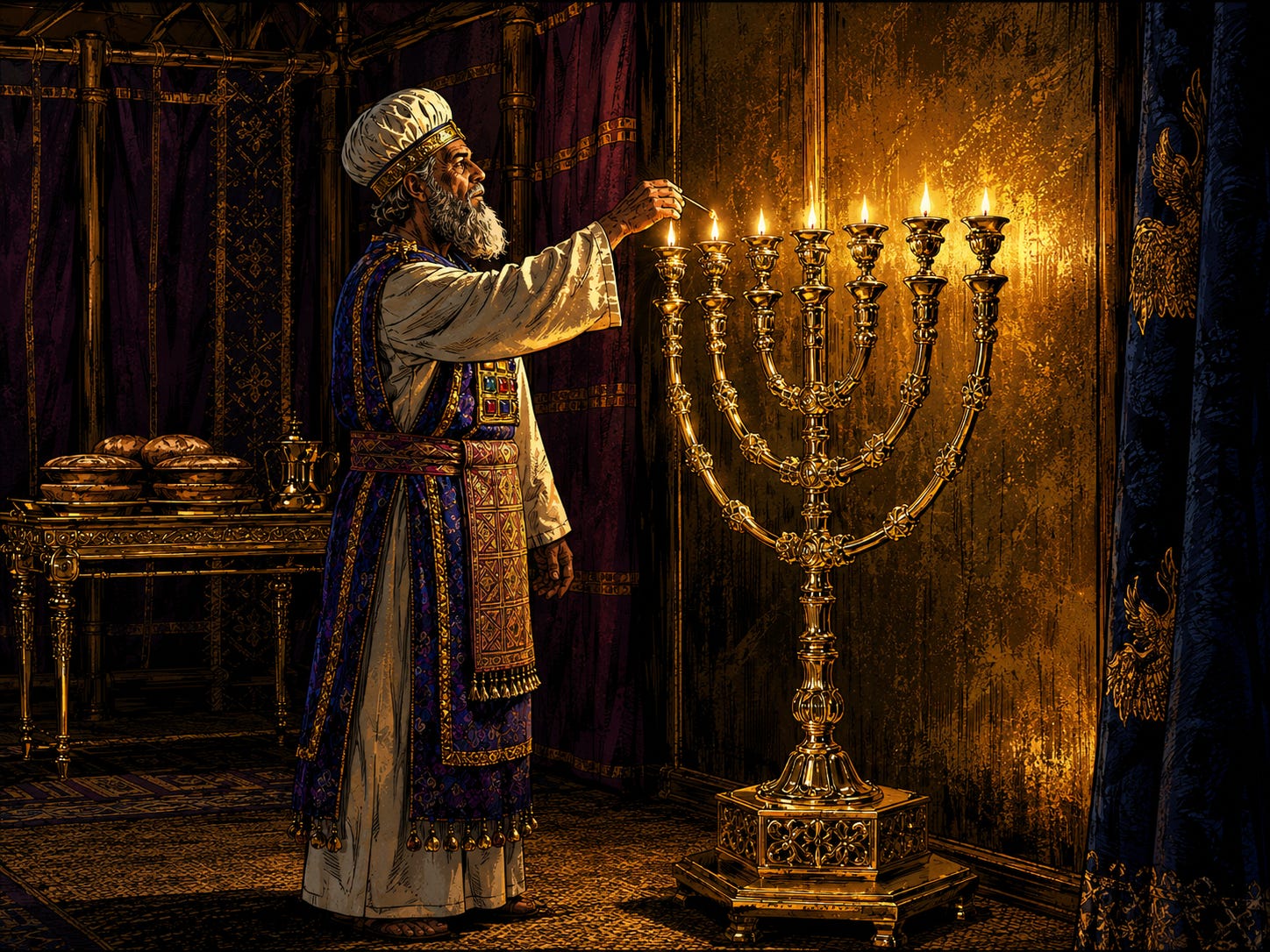
“Adonai said to Moshe, ‘Tell Aharon: When you set up the lamps, the seven lamps are to cast their light forward, in front of the menorah.’ Aharon did this — he set up the lamps so as to cast their light forward, in front of the menorah, as Adonai had ordered Moshe. Here is how the menorah was made: it was hammered gold from its base to its flowers, hammered work, following the pattern Adonai had shown Moshe.” — Numbers 8:1–4 (CJB)
Opening: Why Does the Menorah Appear Here?
Numbers is not a random collection of laws and census lists. It is a narrative of covenant formation — a people being shaped, organized, and consecrated for the presence of Adonai in their midst. To read it well, you must feel the architecture.
Chapter 7 closes with one of the most repetitive passages in all of Torah: twelve tribal leaders, twelve identical offerings, spread across twelve consecutive days before the altar of the Tabernacle. The repetition is deliberate. Every tribe witnessed. Every tribe participated. Every tribe gave the same gift. The covenant community was declared complete and equal before Adonai. The last sound of chapter 7 is Moses entering the Tent of Meeting and hearing the voice of Adonai speaking from above the ark, from between the two cherubim (Numbers 7:89, CJB). The altar has been consecrated. The voice has been heard.
Then chapter 8 opens — and before the Levites are consecrated, before the camp moves, before anything else happens — Adonai turns to the Menorah.
This is not accidental. The sequence is the message. The altar of sacrifice and the lampstand are paired in the Tabernacle’s liturgical logic. The sacrifice establishes the covenant relationship. The light sustains and illuminates it. You cannot have one without the other. Twelve tribes made their offering. Now the light must be set in order. The darkness of the Holy Place will not tend itself.
For the congregation: Adonai’s first word after establishing covenant community is about direction. Which way does your light face?
For the theologian: the structural placement of Numbers 8:1–4 between the dedicatory offerings of chapter 7 and the Levite consecration of 8:5–26 frames the Menorah as the theological hinge — the pivot between Israel’s offering to Adonai and Adonai’s commissioning of those who will serve Him. The lamp must be burning before the servants are set apart.
Part One: The Text and Its Hebrew — What Four Verses Actually Contain
Verse 1 — The Speaker and the Command
“Adonai said to Moshe, ‘Tell Aharon...’”
The chain of transmission matters. Adonai speaks to Moses. Moses speaks to Aaron. The High Priest does not receive this instruction directly — it passes through the mediator. This pattern runs throughout the Tabernacle legislation and anticipates the structure of the Renewed Covenant: Adonai speaks through the mediating Word (Yeshua HaMashiach), and the Word commissions those who tend the lamps of the ekklesia. The command does not originate with the priest. It never did.
Verse 2 — The Direction of the Light
“The seven lamps are to cast their light forward, in front of the menorah.”
The Hebrew is precise and the precision is theological: el mul p’nei hamenorah ya’iru shiv’at haneirot — literally, “toward the face of the menorah shall the seven lamps give light.”
Three Hebrew terms carry the weight here:
El mul — toward, in the direction of, facing. This is directional language. It is not incidental. The lamps are not mounted to scatter light in every direction through the Holy Place. They are directed.
P’nei — face, presence. The same word used in panim el panim — face to face — when Moses met with Adonai (Exodus 33:11, CJB). The lamps face the face of the Menorah — the central shaft, the trunk from which all six branches extend.
Ya’iru — they shall give light, they shall shine. From the root or (אוֹר) — light, the same word from Genesis 1:3: “Yehi or” — “Let there be light.” The seven lamps ya’iru — they are not merely decorative. They function. They illuminate. But the direction of their function is inward toward the source, not outward toward self-display.
The seven-branched Menorah had a central shaft with three branches on the left and three on the right. The six branches, directed toward the center, complete the theological portrait: six is the number of man in Hebrew numerology — created on the sixth day, laboring six days before Sabbath rest. The six branches represent the community, the people, the image-bearers of Adonai. The central shaft is the source from which they extend and toward which their light is oriented. Detached from the center, the six branches are architectural ornament. Connected and directed toward the center, they are a unified light source.
This is not merely lamp-positioning protocol. It is a theology of the people of God: the community’s light is genuine, but it faces the source from which it comes.
Verse 3 — The Obedience of Aaron
“Aharon did this — he set up the lamps so as to cast their light forward, in front of the menorah, as Adonai had ordered Moshe.”
The entire verse is a record of compliance. There is no elaboration, no editorial commentary, no note of Aaron’s inner state. He did what was commanded. He did it the way it was commanded. That is the full report — and in its restraint, it is a sermon.
Contrast this with Leviticus 10:1–2 — Nadab and Abihu, Aaron’s own sons, who offered esh zarah (strange fire, unauthorized fire) before Adonai, fire He had not commanded. The result was immediate and total. The Menorah is not a canvas for priestly creativity. It is a covenant object requiring covenant obedience.
Aaron’s quiet compliance here stands as the answer to Nadab and Abihu’s presumption. The priest’s role is not to innovate before Adonai. It is to execute the pattern faithfully, to tend what has been lit, to face the lamps toward the center, and to step back.
For the congregation: faithful obedience to the pattern Adonai has set is not legalism. It is the posture of a servant who understands that the Tabernacle — and the ekklesia — belongs to Adonai, not to the one who tends it.
For the theologian: the phrase ka’asher tzivah Adonai et Moshe — “as Adonai commanded Moses” — is the refrain of faithful Tabernacle construction throughout Exodus and Numbers. It appears over thirty times. It functions as a covenantal quality mark: the earthly pattern faithfully reflects the heavenly blueprint (Hebrews 8:5, ESV). Every deviation from that pattern, however minor it might appear, corrupts the copy.
Verse 4 — The Workmanship: Hammered Gold
“Here is how the menorah was made: it was hammered gold from its base to its flowers, hammered work, following the pattern Adonai had shown Moshe.”
The Hebrew word is mikshah (מִקְשָׁה) — from the root qashah, meaning hard, difficult, pressed. It is the word for work produced by striking, beating, hammering a material into shape. The Menorah was not cast in a mold, assembled from separate components, or built from multiple pieces joined together. It was beaten out of a single talent of pure gold — one unified piece, shaped by sustained application of force under the direction of the Spirit-filled craftsman Bezalel (Exodus 31:2–5, CJB).
Mikshah appears nine times in the Tanakh, nearly always in reference to the Menorah or the silver trumpets of Numbers 10. It is the vocabulary of sacred workmanship under divine pressure.
The theological content embedded in this single word is profound: the shape that Adonai intended was always present in the gold. The hammer did not create something new from separate raw materials. It drew out, through sustained force, the form that was predetermined by the divine pattern. The Menorah did not become gold through the hammering. It was gold — and the hammering revealed what the gold was always meant to be.
For the congregation: the pressures, trials, and disciplines of the believer’s life are not evidence of abandonment. They are the mikshah process — Adonai beating into visible form what was always present in the identity He declared over you. The hammer does not destroy the gold. It shapes it.
For the theologian: the mikshah construction also eliminates any seam or joint — the Menorah has no vulnerable connection points, no place where two pieces might separate under pressure. It is structurally unified from base to flowers. This is the same unity Yeshua prays for in John 17 — not organizational uniformity but organic, structural oneness flowing from a single source.
Part Two: The Original Blueprint — Exodus 25 and 37
The Menorah first appears in Exodus 25:31–40, where Adonai gives Moses the construction specifications on the mountain. It reappears in Exodus 37:17–24, where Bezalel executes those specifications in the wilderness. The two passages are intentionally parallel — the heavenly pattern and its earthly execution set side by side for the reader.
“You are to make a menorah of pure gold. It is to be made of hammered work; its base, shaft, cups, ring of outer leaves and petals are to be of one piece with it.” — Exodus 25:31 (CJB)
Six branches extend from the central shaft — three on each side. Each branch bears an almond-blossom design: knob, outer leaves, and petals. The almond is significant — the Hebrew word for almond is shaqed (שָׁקֵד), from the root meaning to watch, to be wakeful, to be alert. It is the same root Adonai uses in Jeremiah 1:11–12 when He shows Jeremiah an almond branch and says: “I am watching over my word to perform it.” The almond motif on the Menorah is not decorative flora. It is a declaration that Adonai is awake, attentive, and keeping watch over His light in the midst of His people.
The specifications close with a statement of supreme importance:
“See that you make them according to the pattern for them that was shown to you on the mountain.” — Exodus 25:40 (ESV)
The earthly Menorah is a copy. There is a heavenly original. The author of Hebrews would later make explicit what Moses was shown on Sinai:
“They serve a copy and shadow of the heavenly things. For when Moses was about to erect the tent, he was instructed by God, saying, ‘See that you make everything according to the pattern that was shown you on the mountain.’” — Hebrews 8:5 (ESV)
The Menorah is not a human design given divine approval. It is a heavenly reality given earthly form. When the priests tended the lampstand, they were tending an earthly shadow of something that exists in the presence of Adonai. Revelation 4:5 confirms the heavenly reality — seven torches of fire burning before the throne of God, which are the seven Spirits of Adonai. The Menorah and the Ruach HaKodesh are inseparable from the beginning.
Part Three: The Priestly Discipline — Exodus 27 and Leviticus 24
The Menorah does not tend itself. This is the truth most often overlooked when the lampstand is discussed theologically — and it may be the most practically important truth in the entire passage.
“And you shall command the people of Israel that they bring to you pure beaten olive oil for the light, that a lamp may regularly be set up to burn. In the tent of meeting, outside the veil that is before the testimony, Aaron and his sons shall tend it from evening to morning before Adonai. It shall be a statute forever to be observed throughout their generations by the people of Israel.” — Exodus 27:20–21 (ESV)
Several elements here demand attention.
The oil is pure beaten olive oil — shemen zayit zakh katit in Hebrew. It is not ordinary oil. The word katit shares its root with mikshah — beaten, pressed. The olives were not ground in a mill, which would produce a coarser oil. They were hand-pressed, beaten gently to yield only the purest, clearest oil before the grinding began. The first pressing produced a higher quality of oil than any mechanical process could achieve. This oil was reserved exclusively for the Menorah. It was not used for cooking. It was not used for anointing. It was set apart for the single purpose of keeping the light burning before Adonai.
The lamp was to burn from evening to morning — continuously through the darkness. Leviticus 24:1–4 repeats and expands this command, specifying that Aaron himself — the High Priest — was responsible for setting the lamps in order:
“Command the people of Israel to bring you pure oil from beaten olives for the lamp, that a light may be kept burning regularly. Outside the veil of the testimony, in the tent of meeting, Aaron shall arrange it from evening to morning before Adonai regularly; it shall be a statute forever throughout your generations.” — Leviticus 24:2–3 (ESV)
This was not a task delegated to junior priests and forgotten. The High Priest tended the light. Morning and evening, without fail, the oil was checked, the wicks were trimmed, the lamps were set in order. If the oil ran out, the light went out. If the wicks were not tended, the flame would falter.
For the congregation: the light of your walk with Adonai does not maintain itself on the strength of a past encounter. The fire was lit — yes. But the oil must be replenished. The wick must be tended. The sustained burning of the lamp is not a one-time event. It is a daily discipline of consecration.
For the theologian: the priestly tending of the Menorah is the liturgical enactment of Jeremiah 31:33’s promise — the law written on the heart requires the continuous work of the Ruach HaKodesh to illuminate it. The High Priest tending the lamp every morning and evening is a shadow of Yeshua HaMashiach’s intercessory work before the Father on behalf of those in whom the light of Adonai burns. Hebrews 7:25 states it plainly:
“Consequently, he is able to save to the uttermost those who draw near to God through him, since he always lives to make intercession for them.” — Hebrews 7:25 (ESV)
The High Priest never stopped tending the lamp. Neither does Yeshua.
Part Four: Zechariah 4 — The Spirit Is the Oil
No passage in the entire Tanakh unlocks the Menorah’s meaning more directly than Zechariah 4. If Numbers 8 gives us the command and Exodus gives us the construction, Zechariah gives us the divine commentary — and it arrives in the form of a vision that the prophet himself does not initially understand.
The setting is the post-exilic period. The Temple has been destroyed. The community has returned from Babylon. Zerubbabel has been charged with rebuilding — and the task appears humanly impossible. The resources are insufficient. The opposition is fierce. The people are discouraged. Into this context, the interpreting angel wakes Zechariah and shows him something:
“I looked, and there was a menorah of solid gold with a bowl at the top and seven lamps on it, with seven pipes to the lamps. Next to it were two olive trees, one on the right of the bowl and one on its left.” — Zechariah 4:2–3 (CJB)
Zechariah sees the Menorah — but this version has a crucial addition. There is a bowl at the top. Two olive trees flank it. Seven pipes run from the bowl to the seven lamps. The oil flows from the trees into the bowl and through the pipes continuously to the lamps. There is no priest tending this lampstand. The oil supplies itself — directly from the living trees into the flames — without human interruption.
Zechariah does not understand the vision and says so honestly. The angel’s response is one of the most important interpretive declarations in all of prophetic literature:
“This is the word of Adonai to Z’rubavel: ‘Not by force, and not by power, but by my Spirit,’ says Adonai-Tzva’ot.” — Zechariah 4:6 (CJB)
The angel does not explain the symbol academically. He speaks the application directly into Zerubbabel’s situation and into the reader’s life: the Menorah burns not by human effort, not by organizational muscle, not by political force. It burns by the Ruach HaKodesh.
The oil is the Spirit.
This is not a later theological development imported into the Menorah imagery. It was always there. The pure beaten olive oil of Exodus 27 — set apart exclusively for the lamp, pressed from living fruit, replenished daily — was always a portrait of the Ruach HaKodesh: the presence of Adonai sustaining the light of His people from within, not from a mechanical or external source.
The two olive trees in Zechariah’s vision have been the subject of sustained theological discussion. The angel identifies them as “the two anointed ones who stand by the Lord of all the earth” (Zechariah 4:14, ESV). Revelation 11:3–4 picks up this imagery directly in the two witnesses:
“These are the two olive trees and the two menorahs standing before the Lord of the earth.” — Revelation 11:4 (CJB)
The supply of the Spirit to the lamp is not exhausted. The trees do not run dry. The oil flows from living sources into living flames — continuously, supernaturally, without human management. What Adonai lights, the Ruach HaKodesh sustains.
For the congregation: you are not responsible for generating the oil. You are responsible for remaining connected to the source. The lamp in you was not lit by your own discipline or sincerity. It was lit by the breath of Adonai. Your part is to stay near the tree — to abide in the one who declared, “I am the vine; you are the branches” (John 15:5, ESV). The oil flows from the living source.
For the theologian: Zechariah 4 settles the pneumatological question embedded in the Menorah’s design. The Ruach HaKodesh is not merely the fire that lights the lamp at the moment of new birth. He is the continuous oil supply that sustains the burning. The distinction between the once-for-all lighting and the ongoing sustaining is critical for any theology of sanctification. Ezekiel 36:27 promised: “I will put my Spirit within you, and cause you to walk in my statutes.” The oil does not just ignite obedience. It sustains it.
Part Five: The Temple Trajectory — Solomon, the Exile, and the Silence of the Lamps
When Solomon built the Temple, the single Menorah of the Tabernacle became ten:
“He also made ten menorahs of gold according to the specification for them, and he placed them in the sanctuary, five on the south side and five on the north.” — II Chronicles 4:7 (CJB)
Ten lampstands. The number of divine order and complete testimony in Hebrew numerology is the same number as the Ten Commandments, the ten plagues, and the tithe. Ten Menorot in the Temple declared that the light of Adonai’s presence was the complete testimony of the covenant community before a watching world.
They burned for centuries — through the reigns of faithful kings and unfaithful ones, through reform and apostasy. But the covenant carried consequences as well as promises. The lampstands were among the sacred vessels carried to Babylon when judgment fell. Those wishing to trace the full weight of that moment will find it in II Kings 25:13–17 and Jeremiah 52:17–23 — the inventory of what was taken, the silence that followed, and what the extinguishing of those lamps meant for a people whose light had gone out long before the Babylonians arrived.
The silence of the lamps in exile was not merely a military loss. It was a covenant statement.
But silence is not the end of Adonai’s story. It is the preparation for a greater light.
Part Six: Yeshua HaMashiach — The Central Shaft
When the eternal Word stepped into human history, He did not arrive without context. He arrived as the fulfillment of everything the Menorah had been saying since Sinai.
John opens his Gospel not with a birth narrative but with a declaration that reaches back to the beginning of all things:
“In the beginning was the Word, and the Word was with God, and the Word was God... In him was life, and the life was the light of men. The light shines in the darkness, and the darkness has not overcome it.” — John 1:1, 4–5 (ESV)
B’reishit haya haDavar — In the beginning was the Word. The Logos, the Davar — the one through whom all things were made, in whom was life, who was the light of men. John is not introducing a new concept. He is declaring that the one who spoke the world into existence, who spoke the Torah at Sinai, who commissioned the Menorah as a portrait of His own nature, has now entered the portrait in person.
The light of the Menorah was always pointing somewhere. It was pointing to Him.
Yeshua makes the declaration explicit — and He makes it in the Temple, in the Treasury, near the Court of Women, where the great Temple lampstands stood during the Feast of Sukkot:
“Yeshua spoke to them again: ‘I am the light of the world; whoever follows me will never walk in darkness but will have the light which gives life.’” — John 8:12 (CJB)
The geographical and liturgical context is not incidental. During Sukkot, four massive golden menorot were lit in the Court of Women — towering lampstands that, according to the Mishnah (Sukkah 5:2–3), cast light over all of Jerusalem. The priests danced through the night. The celebration was called Simchat Beit HaSho’evah — the Rejoicing of the House of Water Drawing — and it was said that anyone who had not seen this celebration had never seen joy in their life.
It was in that moment, with those lamps burning, that Yeshua stood and declared: Ani or ha’olam — I am the light of the world.
He was not making a poetic statement. He was identifying Himself as the central shaft of the Menorah. The great Temple menorot were beautiful and true — but they were mikshah, hammered copies, pointing toward something they could not themselves be. The branches face the center. The center has arrived.
He said it again in John 9:5, on the way to healing a man born blind — a man who had never seen light in his life:
“While I am in the world, I am the light of the world.” — John 9:5 (CJB)
And John 1:9 had already stated the comprehensive claim:
“The true light, which gives light to everyone, was coming into the world.” — John 1:9 (ESV)
The true light — to phos to alethinon in Greek, ha’or ha’amiti in the Hebrew thought underlying it. Not a light among lights. Not the brightest of many options. The true light — the original, the source, the one to which all other lights are oriented. The Menorah’s seven lamps facing the central shaft were, from the beginning, facing Him.
Part Seven: Revelation 1 and 2 — The Ekklesia as the Lampstand
When the Revelation of Yeshua HaMashiach opens, the first vision John receives is not of thrones, seals, or plagues. It is of lampstands:
“I turned to see who was speaking to me; and when I had turned, I saw seven gold menorahs, and among the menorahs was someone like a Son of Man...” — Revelation 1:12–13 (CJB)
Seven menorahs. One figure walking among them. Yeshua Himself identifies what John is seeing:
“Here is the secret meaning of the seven stars you saw in my right hand and of the seven gold menorahs: the seven stars are the angels of the seven Messianic communities, and the seven menorahs are the seven Messianic communities.” — Revelation 1:20 (CJB)
The single Menorah of the Tabernacle. The ten Menorot of Solomon’s Temple. Now seven menorahs representing the communities of the Renewed Covenant — the ekklesia. The multiplication of the lampstand from one to seven does not represent fragmentation. It represents the expansion of the same light across the world. Seven is the number of spiritual completeness in Hebrew numerology. Seven lampstands burning across seven communities is the complete covenant light of Adonai present in the world through the body of Messiah.
But notice where Yeshua stands: among the lampstands. Not above them. Not behind them. In their midst. The central shaft has not disappeared — He is walking through the lamps, present with every flame, sustaining every light by His nearness. This is not distant administration. This is the High Priest making His rounds, checking the oil, tending the wicks — exactly as Aaron did in the Tabernacle, but now in the fullness of His eternal priesthood.
And then comes the warning — one of the most sobering in all of the Renewed Covenant writings:
“But I have this against you: you have left your first love. Therefore, remember where you were before you fell, turn from this sin, and do what you used to do before. Otherwise, I will come to you and remove your menorah from its place — if you don’t turn from your sin!” — Revelation 2:4–5 (CJB)
The removed lampstand. This is the covenant consequence that the exile foreshadowed — not merely a political judgment, not merely organizational irrelevance, but the actual removal of the lamp from its place. A lampstand without its lamp is furniture. An ekklesia that has left its first love — that has turned its lamps away from the central shaft toward self-preservation, reputation, or human agenda — is not a community of light. It is a community of darkened wicks.
The warning presupposes the promise: the lamp can be restored. The call is to remember, repent, and return to the first works — the same pattern of covenant restoration that runs from Deuteronomy through the prophets. The lampstand has not yet been removed when the letter is written. There is still time to turn the lamps back toward the center.
For the congregation: the question Revelation 2 presses upon every believer and every community is the question Numbers 8:2 embedded in four verses of Torah — which direction are your lamps facing? Toward the central shaft, toward Yeshua HaMashiach — or toward the things that have accumulated around the edges of your devotion?
For the theologian: the seven letters of Revelation 2–3 are themselves structured as covenant lawsuit documents — a form that runs from Deuteronomy through the classical prophets. The warning against the removed lampstand is not a new theological invention. It is the covenant logic of Leviticus 26 and Deuteronomy 28 applied to the communities of the Renewed Covenant. The Menorah’s presence among the people of Adonai has always been conditional upon their orientation toward the source.
Closing: The Menorah as Theological Spine
From Sinai to the Upper Room. From the wilderness Tabernacle to the Court of the Temple. From the rebuilding under Zerubbabel to the seven communities of the first-century ekklesia. From the vision of Zechariah to the Revelation of Yeshua HaMashiach. The Menorah runs through the entire canon of Scripture without breaking — not as a recurring symbol that means different things in different eras, but as a single, unified theological statement that deepens with every appearance.
The statement is this:
Adonai is light. His people are called to bear that light in the world. The light does not originate with the people — it flows from the central shaft, sustained by the pure oil of the Ruach HaKodesh, tended by the eternal High Priest, burning through the darkness of every age in which Adonai has planted His lamp. The people’s role is not to generate the fire. It is to face the source, stay connected to the oil supply, and keep the wicks trimmed through the daily discipline of consecrated living.
The hammer fell on the gold, and the Menorah took shape. The hammer fell on the Messiah — “it pleased Adonai to crush him” (Isaiah 53:10, CJB) — and through that mikshah moment, the fullness of the light entered the world. Now the same process continues in those who belong to Him:
“For we who live are always being given over to death for Jesus’ sake, so that the life of Jesus also may be manifested in our mortal flesh.” — II Corinthians 4:11 (ESV)
The hammered work produces a single piece. No seams. No joints. From base to flowers, mikshah — beaten into the image of the one who is the central shaft, the true light, the one who walks among the lampstands and calls every lamp back to its original orientation.
El mul p’nei hamenorah ya’iru — toward the face of the Menorah shall the lamps give light.
Turn your lamp toward the center.
Baruch HaShem Yeshua HaMashiach — Blessed is the Name of Yeshua the Messiah.
Scripture Copyright Notices
Complete Jewish Bible (CJB) Copyright © 1998 by David H. Stern. All rights reserved. No portion of this book may be reproduced, stored in a retrieval system, or transmitted in any form or by any means without prior written permission of the publisher. Published by Jewish New Testament Publications, Inc. / Messianic Jewish Publishers.
New American Standard Bible (NASB) Scripture quotations taken from the (NASB®) New American Standard Bible®, Copyright © 1960, 1971, 1977, 1995, 2020 by The Lockman Foundation. Used by permission. All rights reserved. lockman.org
English Standard Version (ESV) Scripture quotations are from the ESV® Bible (The Holy Bible, English Standard Version®), copyright © 2001 by Crossway, a publishing ministry of Good News Publishers. Used by permission. All rights reserved. The ESV text may not be quoted in any publication made available to the public by a Creative Commons license. The ESV may not be translated in whole or in part into any other language.
King James Version (KJV) The King James Version of the Bible is in the public domain in the United States of America.