
"In My Name": Authority, Identity, and the Power Behind the Phrase
A Messianic Teaching — B'Shem Yeshua HaMashiach

“And whatever you ask in My name, that I will do, so that the Father may be glorified in the Son. If you ask Me anything in My name, I will do it.” — Yeshua (John 14:13–14, NASB)
“Truly, truly I say to you, whatever you ask the Father, He will give you in My name. Until now you have asked for nothing in My name; ask and you will receive, so that your joy may be made full.” — Yeshua (John 16:23–24, NASB)
Introduction: The Question Behind the Phrase
When Yeshua instructed His disciples to act and pray “in His name,” He was communicating something far richer than a verbal formula appended to the end of a prayer. The popular practice of closing a prayer with “...in Jesus’ name, Amen” — while not wrong in itself — can inadvertently reduce a profound covenantal and legal concept to a ritual incantation.
The question before us is this: Did Yeshua mean the physical utterance of His name, or was He commissioning His disciples to operate within His delegated authority?
The answer, drawn from Scripture, Jewish law, ancient history, rabbinic literature, and even secular jurisprudence, is unambiguous — and far more empowering than either option alone might suggest.
Part One: The Hebrew Concept of Shem (שֵׁם) — “Name”
Name as Identity and Essence
In ancient Hebrew thought, a person’s name was never merely a label. It was a living expression of character, nature, calling, and authority. The shem (name) of a person was understood to be inseparable from the person themselves.
Consider the biblical pattern:
Abram → Abraham — “No longer shall your name be called Abram, but your name shall be Abraham; for I have made you the father of a multitude of nations.” (Genesis 17:5) — The new name reflected the new identity and covenant assignment.
Jacob → Israel — “Your name shall no longer be Jacob, but Israel; for you have striven with God and with men and have prevailed.” (Genesis 32:28) — The change of name marked a transformed purpose and authority.
Yeshua (יֵשׁוּעַ) — His very name means “YHWH saves” or “YHWH is salvation.” This was not incidental. Matthew 1:21 records the angel’s instruction: “You shall call His name Jesus, for He will save His people from their sins.” The name carried the mission.
The Divine Name and Its Weight
The Third Commandment — “You shall not take the name of the LORD your God in vain” (Exodus 20:7) — is frequently misunderstood as a prohibition against casual profanity. The Hebrew word translated “in vain” is shav’ (שָׁוְא), which means emptiness, falseness, or without purpose. To carry or invoke the Divine Name “in vain” meant to use it without the backing of righteous representation — to invoke God’s authority while acting contrary to His character.
This understanding is foundational to everything Yeshua taught about acting in His name.
Part Two: The Rabbinic Law of Shaliach (שָׁלִיחַ) — Agency
The Principle
One of the most critical and under-appreciated concepts for understanding “in My name” is the Jewish legal institution of the shaliach — the authorized agent or emissary.
The governing principle, codified in the Talmud, is:
“A man’s agent (shaliach) is as himself.” — Kiddushin 41b; Berachot 34b (Babylonian Talmud)
“שלוחו של אדם כמותו” (Shelucho shel adam k’moto) — “The agent of a man is like the man himself.”
This principle governed virtually all of Jewish commercial, legal, and religious life. When a man appointed a shaliach, that agent could:
Enter legal contracts in the principal’s name
Represent the principal in court
Receive payment or deliver goods as though the principal himself were present
Perform certain religious duties (like bringing a sacrifice) on behalf of the one who sent him
The shaliach was not merely a messenger — he was a legal extension of the sender’s person. The authority of the shaliach was real, transferable, and binding.
The Apostles as Shlichim
The Greek word apostolos (ἀπόστολος), typically translated “apostle,” is the exact Greek equivalent of the Hebrew shaliach. It comes from the verb apostellō — “to send out with delegated authority.”
When Yeshua said, “As the Father has sent Me (apestalken), I also send you (apostellō)” (John 20:21), He was using the formal language of shaliach-appointment. He was constituting His disciples as His authorized agents, empowered to act in His stead.
Implication for “In My Name”
To pray or act b’shem Yeshua (”in the name of Yeshua”) is therefore to operate as His shaliach — as one legally authorized to represent Him. It is not a magic password. It is a declaration of agency: “I am acting under the authority and in accordance with the character and mission of the One who sent me.”
This is why the apostles could say to the lame man at the Gate Beautiful:
“I do not possess silver and gold, but what I do have I give to you: In the name of Jesus Christ the Nazarene, walk!” (Acts 3:6)
Peter was not invoking a verbal spell. He was acting as the legally commissioned representative of Yeshua HaMashiach — drawing on deposited authority.
Part Three: Old Testament Precedents — Acting “In the Name of YHWH”
The pattern of acting and speaking “in the name of” a sender is deeply embedded in the Tanakh (Hebrew Scriptures).
Prophets as Shlichim of YHWH
“I will raise up a prophet from among their countrymen like you, and I will put My words in his mouth, and he shall speak to them all that I command him.” (Deuteronomy 18:18)
“Thus says the LORD” — this formula, appearing over 400 times in the Hebrew prophets, is the hallmark of agency. The prophet was speaking in the name of YHWH, as His commissioned representative.
Jeremiah was explicitly warned against prophesying without this commission: “I did not send these prophets, but they ran. I did not speak to them, but they prophesied.” (Jeremiah 23:21) — To speak “in the name of YHWH” without true appointment was the gravest of offenses.
The Priest and the Blessing
“So they shall invoke My name on the sons of Israel, and I then will bless them.” (Numbers 6:27)
The Aaronic Blessing was not a magical formula. The priests were instructed to “put the name” (שִׂים אֶת-שְׁמִי) of YHWH upon Israel — to function as agents through whom the Divine blessing was channeled. The name represented the authority and presence of the One who authorized the blessing.
David’s Warriors in the King’s Name
In 1 Samuel 25:9, David’s servants approach Nabal “in the name of David” — “When David’s young men came, they spoke to Nabal in accordance with all these words in David’s name.” This was a formal invocation of David’s authority and backing.
Part Four: New Testament Expansion — What Yeshua Meant
The Commissioning Passages
Matthew 28:18–20 (The Great Commission):
“All authority has been given to Me in heaven and on earth. Go therefore and make disciples of all the nations, baptizing them in the name of the Father and the Son and the Holy Spirit.”
Note the logical structure: because all authority has been given to Yeshua, therefore go and act in that name. The authority precedes and undergirds the mission. “In the name of” is the mechanism of legal authorization.
John 14:13–14:
“Whatever you ask in My name, that I will do, so that the Father may be glorified in the Son.”
The qualifier here is vital — that the Father may be glorified in the Son. This rules out self-serving or arbitrary requests. To pray “in Yeshua’s name” is to pray as His representative, in alignment with His will and character, for purposes consistent with His mission.
John 16:26:
“In that day you will ask in My name, and I do not say to you that I will request the Father on your behalf.”
Here Yeshua distinguishes between two modes of access. The disciples are not merely benefiting from His intercession — they are themselves being given standing before the Father through His name. This is ambassador-level authorization.
Colossians 3:17:
“Whatever you do in word or deed, do all in the name of the Lord Jesus, giving thanks through Him to God the Father.”
Paul here extends the principle beyond prayer to encompass the entirety of the believer’s life. Every action is to be performed as a representative of Yeshua — as His shaliach.
The Name That Commands Obedience
“...so that at the name of Jesus every knee will bow, of those who are in heaven and on earth and under the earth.” (Philippians 2:10)
The “name” here is not merely a sound. Paul is referencing the authority and identity that the name conveys. The Septuagint (Greek Old Testament) uses this same construction in Isaiah 45:23 — there spoken of YHWH Himself. Paul’s application of this text to Yeshua is a profound theological claim: that Yeshua bears the name that carries YHWH’s own authority.
Part Five: Talmudic and Rabbinic Sources in Depth
Mishnah Berachot and the Direction of Prayer
The Mishnah tractate Berachot addresses the proper orientation and intention of prayer. The concept of kavanah (כַּוָּנָה) — intentional direction of the heart — was essential. Prayers were not efficacious by virtue of words alone but by the alignment of heart, intention, and relationship.
“One who prays must direct his heart toward Heaven.” — Mishnah Berachot 5:1
This principle maps directly onto Yeshua’s instruction: to pray “in His name” is not to utter syllables but to align one’s heart with His purposes, standing as His representative before the Father.
The False Prophet and the Unauthorized Name
The Talmud tractate Sanhedrin addresses prophets who speak without authorization:
“A prophet who presumes to speak in My name what I have not commanded him to speak...” (Deuteronomy 18:20)
The Rabbis discussed extensively what it meant to truly speak “in the name of” God versus speaking fraudulently. The governing principle was representation: did the person truly represent the character, will, and mission of the One whose name they invoked?
Agency in Gittin and Kiddushin
The Talmudic tractates dealing with divorce and betrothal extensively develop the law of agency (shlichut). A get (divorce document) delivered by an agent was legally valid as if delivered by the husband himself. The agent acted with full legal standing — not a diminished or symbolic standing.
“Just as a man can betroth [a woman] himself, so too can he betroth [her] through an agent.” — Kiddushin 41a
This is the exact legal framework Yeshua employed when He authorized His disciples to act “in His name.”
Part Six: Secular Legal Parallels
The concept Yeshua invoked was not foreign even to secular legal traditions. Several legal frameworks illuminate what “in my name” means as a mechanism of delegated authority.
Roman Law — Nomen and Mandatum
In Roman law, the concept of mandatum (commission/agency) allowed one person to legally authorize another to act on their behalf. The agent acting under mandatum had legal standing to bind the principal — their actions were treated as the principal’s own.
Additionally, Roman law recognized that one who acted in nomine (in the name of) a patron or magistrate carried their authority. Roman officials frequently acted in nomine Caesaris — in the name of Caesar — meaning they carried the full legal weight of the Emperor’s commission.
This is the world into which the Gospel spread, and to Greco-Roman ears, “in the name of Jesus Christ” would have been heard precisely as a claim of delegated imperial-level authority.
English Common Law — Power of Attorney
The modern legal instrument most analogous to the shaliach principle is the Power of Attorney (POA). Under a POA:
One person (the principal) grants another (the agent/attorney-in-fact) the legal authority to act on their behalf.
The agent may sign documents, enter contracts, manage property, and conduct transactions as though they were the principal.
Actions taken within the scope of the POA are legally binding on the principal.
The phrase “in the name of” appears throughout POA documents precisely because it is the legal signal of delegated authority. When a POA agent signs “John Smith, by Jane Doe as Attorney-in-Fact,” they are acting “in the name of” John Smith.
Yeshua’s commissioning of His disciples functions analogously: He granted them the legal standing of His authorized agents, empowered to act in His name — with His authority backing their actions.
The Ultra Vires Principle — Acting Beyond One’s Authority
In corporate and agency law, the doctrine of ultra vires (Latin: “beyond the powers”) holds that acts performed outside the scope of one’s authorized authority are void or voidable. An agent who exceeds the authority granted by the principal acts ultra vires and cannot bind the principal.
This legal concept illuminates a vital corrective: one cannot pray or act “in the name of Jesus” for purposes contrary to His will and character without acting ultra vires. The name is not a blank check — it is authorization within the scope of His mission and character. This is why John cautions:
“This is the confidence which we have before Him, that, if we ask anything according to His will, He hears us.” (1 John 5:14)
Acting “in His name” and acting “according to His will” are two expressions of the same reality.
Part Seven: Historical Context — Names and Authority in the Ancient World
Ancient Near East
Throughout the ancient Near Eastern world — Mesopotamia, Egypt, Canaan — a ruler’s name was the embodiment of his power. Royal decrees were issued “in the name of” the king, and they carried the full force of royal authority. To act “in the name of Pharaoh” was to act as Pharaoh’s extension.
Seals bearing a king’s name or symbol were used to authenticate documents and authorize actions. The one bearing the king’s seal was the king’s representative.
Second Temple Judaism and the Divine Name
In Second Temple Judaism (ca. 530 BCE – 70 CE), the Shem HaMeforash (שֵׁם הַמְּפֹרָשׁ) — the explicit/ineffable Name of God (the Tetragrammaton, YHWH) — was considered so holy that only the High Priest could pronounce it, and only once a year, on Yom Kippur, in the Holy of Holies.
The common Jewish practice was to substitute Adonai (LORD) when reading Scripture. This was not because the Name lacked power — quite the opposite. The Name was considered so freighted with divine authority that its utterance required supreme qualification and context.
When the early disciples preached and acted “in the name of Yeshua,” this was a radical theological claim: that Yeshua bore the authority of the Divine Name in His own person. This is why the Sanhedrin responded with such alarm:
“What shall we do with these men? For the fact that a noteworthy miracle has taken place through them is apparent to all who live in Jerusalem, and we cannot deny it. But so that it will not spread further among the people, let us warn them to speak no longer to any man in this name.” (Acts 4:16–17)
They understood exactly what “in His name” meant — it was a claim of divine authorization.
Part Eight: The Utterance Question — Does the Sound Matter?
What the Early Church Practiced
The book of Acts shows early believers explicitly invoking the name of Yeshua in healing and deliverance:
“In the name of Jesus Christ the Nazarene, walk!” (Acts 3:6) “Aeneas, Jesus Christ heals you.” (Acts 9:34) “I command you in the name of Jesus Christ to come out of her!” (Acts 16:18)
The verbal invocation was clearly practiced. But it is equally clear from these texts that the power was not in the phonetic utterance — it resided in the authority of the One whose name was invoked, and in the genuine agency of the one invoking it.
The Sons of Sceva — A Sobering Warning
Acts 19:13–16 records a decisive test case:
“But also some of the Jewish exorcists, who went from place to place, attempted to name over those who had the evil spirits the name of the Lord Jesus, saying, ‘I adjure you by Jesus whom Paul preaches.’ ...And the man, in whom was the evil spirit, leaped on them and subdued all of them and overpowered them, so that they fled out of that house naked and wounded.”
The sons of Sceva used the correct sounds. They invoked the right name phonetically. But they had no relationship with Yeshua, no appointment as His shlichim, and therefore no standing. The evil spirit itself recognized this: “I recognize Jesus, and I know about Paul, but who are you?” (Acts 19:15).
The utterance alone was powerless. The authority behind the utterance was everything.
The Linguistic Evidence
The Greek phrase used throughout the New Testament is en tō onomati (ἐν τῷ ὀνόματι) — “in the name of.” This is a positional/relational preposition construction, not merely a verbal formula. It denotes operating within the sphere of someone’s authority and identity — not simply pronouncing their title.
New Testament scholar David Bivin (Jerusalem Perspective) has noted that this Greek phrase corresponds to the Hebrew b’shem (בְּשֵׁם), which in rabbinic usage consistently denoted authorized representation: “on behalf of,” “as the agent of,” “in the authority of.”
Part Nine: Scholarly Perspectives
N.T. Wright
In The New Testament and the People of God (1992) and Simply Jesus (2011), Wright argues that “in the name of Jesus” throughout the New Testament is a regnal claim — it asserts that Yeshua is the rightful King through whom the Kingdom of God is breaking into the world. To act “in His name” is to be an agent of that Kingdom, acting under Royal commission.
Wright writes that the early church’s use of “the name” was understood as a claim that Jesus held the authority the ancient world attributed to Caesar — and more, to YHWH Himself.
Kenneth Wuest
Wuest, in his Word Studies in the Greek New Testament, comments on John 14:13-14:
“The words ‘in my name’ do not refer to the mere use of the name as a formula, but rather to asking in the full awareness of all that the name implies — all that He is. To ask in His name is to ask on His authority as His representative.”
David Stern (Jewish New Testament Commentary)
Stern, in his Jewish New Testament Commentary, notes that the phrase “in the name of” in first-century Jewish legal practice was ipso facto the language of shlichut (agency):
“Asking ‘in Yeshua’s name’ means asking as his agent, his shaliach, in a way consistent with his will and character — not as a magical formula.”
Ray VanderLaan (That the World May Know Ministries)
VanderLaan, drawing on his extensive study of first-century Jewish culture, teaches that a rabbi’s disciples were sent out not merely to convey his teachings but to embody and represent the rabbi — to be his shlichim. When Yeshua sent out the Twelve, He was using the full weight of the rabbinic-shaliach institution. His disciples were not delivering messages about Him — they were extensions of His presence and authority.
Gordon Fee
In God’s Empowering Presence (1994), Fee argues that the Spirit’s role is inseparable from acting “in the name” of Yeshua. The Spirit authenticates genuine agency and empowers those who are truly sent. Fee writes that the Spirit is the guarantee that the agent is genuine — the internal validation of the external commission.
James D.G. Dunn
In The Theology of Paul the Apostle (1998), Dunn observes that “the name” of Jesus in Pauline thought is the locus of divine power and identity. Paul’s understanding of the name draws on the LXX pattern in which kyrios (Lord) substitutes for YHWH — meaning that to act “in the name of the Lord Jesus” is to act within the sphere of divine authority itself.
Part Ten: Practical Theology — What This Means for the Believer
You Are a Shaliach
If you are in covenant with Yeshua HaMashiach, you are His appointed shaliach. His commission to the disciples was not restricted to the Twelve:
“Truly, truly, I say to you, the one who believes in Me, the works that I do, he will do also; and greater works than these he will do.” (John 14:12)
To pray and act “in His name” is your legal standing — not something you must earn but something that has been granted to you through covenant relationship.
Alignment Is the Key
Because acting “in His name” means acting as His authorized representative, there is an intrinsic qualifier: your actions and prayers must align with His character, His will, and His mission. A shaliach who acts outside the principal’s instructions does not bind the principal.
This is not a limitation — it is a guide. When you are aligned with His will:
“If you abide in Me, and My words abide in you, ask whatever you wish, and it will be done for you.” (John 15:7)
The “whatever you wish” is not a blank check to the unregenerate self — it is the freedom of the one who has so internalized the Master’s will that their desires and His desires have become aligned.
The Priestly Dimension
Numbers 6:27 gave the priests the authority to invoke the divine name over Israel. Revelation 1:6 declares that Yeshua “has made us to be a kingdom, priests to His God and Father.” Every believer now carries priestly authority — the right to invoke the name of the Lord over people, situations, and circumstances.
This is not presumption. It is the fulfillment of the priestly commission extended to the whole people of God through the New Covenant.
Beyond Prayer — A Way of Life
Colossians 3:17 makes the scope clear: “Whatever you do in word or deed, do all in the name of the Lord Jesus.” This transforms the entire believer’s life into an act of representation. Every conversation, every decision, every relationship is an opportunity to act as His shaliach — to embody His character and extend His authority into the world.
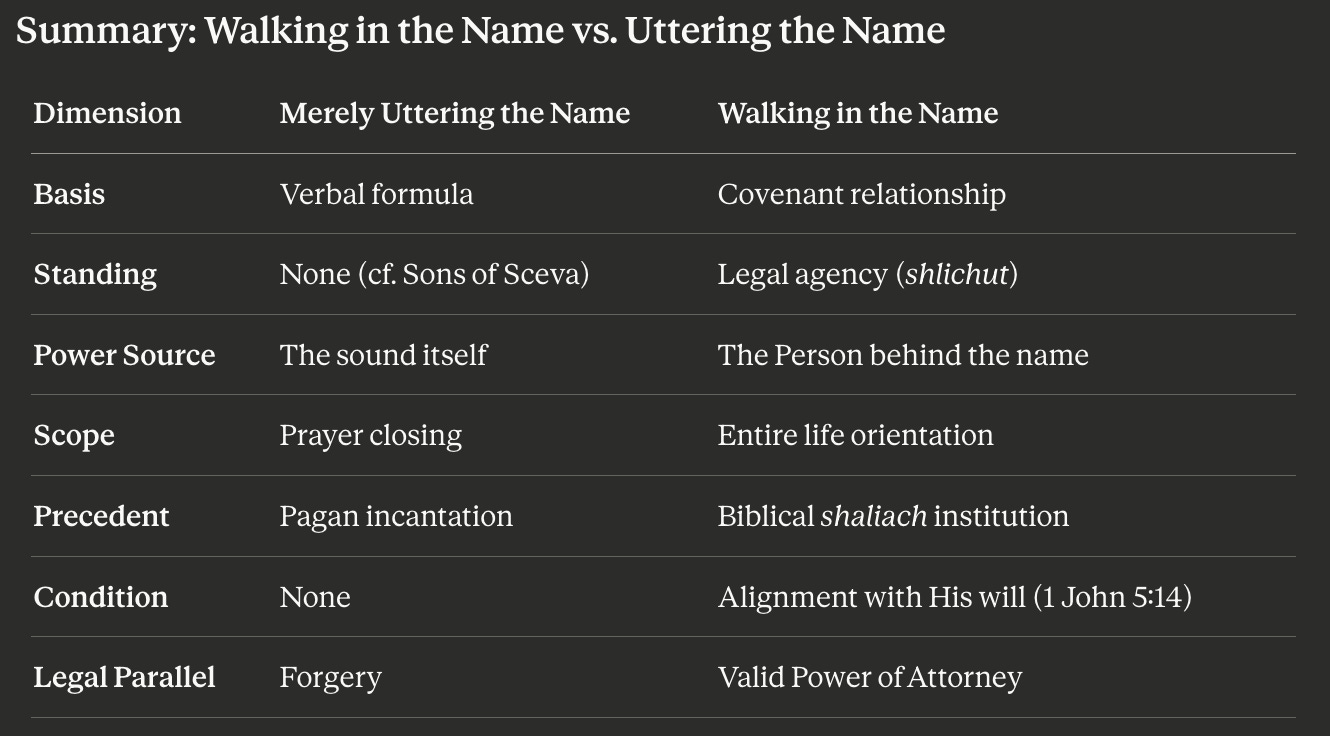
Summary: Walking in the Name vs. Uttering the Name
Conclusion
When Yeshua said to pray and act b’shem — in His name — He was not instituting a verbal ritual. He was extending to His disciples the full weight of the shaliach institution that undergirded Jewish legal, prophetic, and priestly life. He was saying: “You are my authorized agents. My authority is your authority — within the scope of my mission and character. Act accordingly.”
This is at once more humbling and more empowering than any formula. It demands genuine relationship, genuine alignment, and genuine representation. But it also means that the believer who walks in covenant fidelity with Yeshua carries an authority that is neither self-generated nor symbolic — it is the delegated authority of the King of Kings, backed by heaven’s full legal weight.
“And whatever you do in word or deed, do all in the name of the Lord Jesus, giving thanks through Him to God the Father.” (Colossians 3:17)
You are not merely saying His name. You are living it.
Selected Bibliography and References
Scripture
Genesis 17:5; 32:28
Exodus 20:7; 3:14–15
Numbers 6:22–27
Deuteronomy 18:18–20
1 Samuel 25:9
Jeremiah 23:21
Isaiah 45:23
Matthew 28:18–20
John 14:12–14; 15:7; 16:23–26; 17:11–12; 20:21
Acts 3:6; 4:12, 16–17; 9:34; 16:18; 19:13–16
Romans 10:13
Philippians 2:9–10
Colossians 3:17
1 John 5:14
Revelation 1:6
Talmud and Rabbinic Literature
Babylonian Talmud, Kiddushin 41a, 41b
Babylonian Talmud, Berachot 34b
Babylonian Talmud, Sanhedrin 89a–b
Babylonian Talmud, Gittin 62b
Mishnah, Berachot 5:1
Mishnah, Avot 4:2
Tosefta Kiddushin 4:1
Published Scholarly Works
Bivin, David. New Light on the Difficult Words of Jesus. En-Gedi Resource Center, 2005.
Dunn, James D.G. The Theology of Paul the Apostle. Eerdmans, 1998.
Fee, Gordon D. God’s Empowering Presence: The Holy Spirit in the Letters of Paul. Hendrickson, 1994.
Lohse, Eduard. “ὄνομα.” Theological Dictionary of the New Testament, Vol. 5. Eerdmans, 1968.
Safrai, Shmuel, and M. Stern (eds.). The Jewish People in the First Century. Fortress, 1976.
Stern, David H. Jewish New Testament Commentary. Jewish New Testament Publications, 1992.
VanderLaan, Ray. Faith Lessons series. Zondervan/That the World May Know Ministries.
Wright, N.T. The New Testament and the People of God. Fortress, 1992.
Wright, N.T. Simply Jesus. HarperOne, 2011.
Wuest, Kenneth S. Word Studies in the Greek New Testament. Eerdmans, 1973.
Secular and Legal References
Blackstone’s Commentaries on the Laws of England (1765) — Foundational treatment of agency law in the common law tradition.
Restatement (Third) of Agency (2006), American Law Institute — The governing U.S. legal framework for agency relationships and delegated authority.
Buckland, W.W. A Text-Book of Roman Law from Augustus to Justinian. Cambridge University Press, 1921 — Treatment of mandatum and nomen in Roman legal tradition.
Powers of Attorney Act (various jurisdictions) — Legislative embodiment of delegated authority “in the name of” a principal.
Black’s Law Dictionary (11th ed., 2019) — Definitions of agency, power of attorney, ultra vires, in nomine.
“As a man thinks in his heart, so is he.” (Proverbs 23:7a)
You bear His name. Walk in it.
Credits and transparency

This teaching was prepared by Minister Brian Webb, using the following tools.
E-Sword: Thayer’s Lexicon
E-Sword: NASB and CJB Bibles
Online Black’s Law Dictionary
E-Sword: with purchased extra content.
Blue Letter Bible (BLB), because, wow, I like their site, though I still use E-Sword more often.
Grammarly. I sure am thankful for this tool. English may be my first language, but grammar and spelling have been my nemesis.
Agentic Claude. I don’t have research assistants or interns to help me with finding key verses and references. Also translating from Hebrew and Greek.
Illustrations from ChatGPT.
I pray you appreciate this complete transparency on my research.