From Eden to Resurrection: A Torah-to-Resurrection View of Yeshua’s Work
[Some email clients may not show the whole article. Please go to the website for the whole article]

“As a man thinks in his heart, so is he.” — Proverbs 23:7a
“For all the promises of God find their Yes in him.” — 2 Corinthians 1:20
Preface: Who This Is For
This document is written for two distinct readers who share a common need.
The first reader is someone genuinely wrestling with the sacrifice of Yeshua (Jesus) on the cross. Perhaps you find it morally confusing — why would a loving God require a blood sacrifice? Perhaps it seems primitive, arbitrary, or disconnected from the God of the Hebrew scriptures you may have some familiarity with. This document is written to show you that nothing about the cross was arbitrary. It was the planned destination of a covenant arc that Adonai (the Lord) had been building across thousands of years of recorded history. When you understand what the cross was completing, rather than only what it was doing in the moment, it becomes not a stumbling block but the most coherent single act in human history.
The second reader is an apologist — someone engaged in defending the Word of God against those who misrepresent it, whether to deny the messiahship of Yeshua, to claim that the New Testament (Brit Chadasha — “New Covenant writings”) contradicts the Hebrew scriptures (Tanakh), or to argue that figures like the Apostle Paul invented a new religion disconnected from the God of Israel. This document is written to equip you with the covenant framework, the prophetic record, and the historical evidence needed to answer those objections on their own ground, in the language of the very scriptures those objections draw from.
A note on language: Throughout this document, Hebrew and Greek terms are included where they illuminate meaning that translation may obscure. A plain English explanation always follows immediately. The depth is offered for those who want it; the meaning is never hidden behind it.
Part One: The Architecture of the Covenants
The Pattern: Top-Down, Always
Every major covenant (b’rit — “covenant,” from a root meaning “to cut,” because covenants in the ancient world were ratified by cutting animals as a solemn oath) recorded in the Tanakh shares one defining characteristic: it was initiated by God, not by humanity. These are not negotiations. They are not contracts between equals. They are royal grants — declarations from the Creator of the universe to his creation, each one carrying obligations and promises, each one ratified in a different and increasingly significant manner.
This is what critics miss when they ask, “Why would God need a blood sacrifice?” The answer is that God did not need it in the sense of being compelled by anything outside himself. He chose it as the culminating ratification of a covenant pattern he had been establishing since Eden. The cross was not an improvisation. It was the destination.
Covenant 1: The Adamic Covenant — The Foundation
Reference: Genesis 1–3
Ratified by: The spoken word of God; the breath of life (nishmat chayyim — “the breath of lives”)
In the beginning, Adonai creates. He speaks, and creation obeys. Into this creation he places humanity — not as slaves, but as image-bearers (b’tzelem Elohim — “in the image of God,” Genesis 1:27), stewards of a world they did not make. The first covenant is implicit but total: God gives life, provision, relationship, and purpose. The human is given one prohibition. The human breaks it.
The Adamic covenant establishes the foundational problem that all subsequent covenants will address: humanity is given everything and chooses the one thing withheld. Sin (chet — “missing the mark,” like an arrow falling short of its target) is not primarily about individual moral failures. It is about the fracture in relationship between the Creator and his image-bearers. The rest of the Bible is the story of how Adonai, entirely on his own initiative, moves to repair that fracture.
Even in the moment of judgment, a promise is embedded. Genesis 3:15 — the proto-evangelion (Greek: “the first good news,” the earliest gospel announcement) — declares that the seed of the woman will crush the head of the serpent, though at cost to himself. The resolution of the entire story is announced in the third chapter of the first book.
What it established: The problem (sin and broken relationship), the pattern (God speaks and initiates), and the first promise (a coming deliverer who will prevail, but at personal cost).
Covenant 2: The Noahic Covenant — The Preservation
Reference: Genesis 6–9
Ratified by: The rainbow (keshet — “bow,” the same word used for a warrior’s bow, here hung up as a sign that the war of judgment was over)
Humanity spirals. The corruption becomes so pervasive that Adonai judges the earth with a flood. But even here, his initiative is grace — he saves Noah (Noach — “rest” or “comfort”), his family, and enough of creation to begin again. After the flood, God makes a covenant not only with Noah and his descendants, but explicitly with all living creatures (Genesis 9:10).
The terms are simple and entirely unconditional on God’s side: he will never again destroy all life by flood. The rainbow is the sign — remarkably, described as a sign for God himself to look upon and remember (Genesis 9:16). Adonai binds himself. He is not compelled by any external power. He chooses to limit himself as a commitment to creation.
What it established: The preservation of the world as the stage on which the rest of the covenant story will unfold. Before he can permanently deal with sin, God guarantees that the world will survive the process.
Covenant 3: The Abrahamic Covenant — The Promise Takes Shape
Reference: Genesis 12, 15, 17
Ratified by: The covenant-cutting ceremony with animals; God passing through alone as a smoking firepot and flaming torch (Genesis 15); circumcision (b’rit milah — “the covenant of cutting”) as the ongoing sign (Genesis 17)
Here, the covenant narrative narrows its focus from all of humanity to one man, one family, one people — through whom all the families of the earth will be blessed (Genesis 12:3). This is not exclusion; it is method. A craftsman who wants to build something for everyone must start with specific materials. He does not build the whole house at once. He lays a foundation first.
The ratification scene in Genesis 15 is one of the most theologically loaded moments in the entire Tanakh. Abram brings animals, cuts them in half, and lays the pieces in two rows. In the ancient Near Eastern world, both parties to a covenant would walk between the severed pieces, making a solemn oath: “May what happened to these animals happen to me if I break this covenant.”
But Adonai causes Abram to fall into a deep sleep. And then God alone — appearing as a tanur ashan(smoking firepot) and a lapid esh (flaming torch), a physical manifestation of his presence called a theophany — passes between the pieces. Abram does not walk. God walks alone.
This is a unilateral covenant. God takes all the obligation on himself, essentially swearing: if this covenant is ever broken, the penalty falls on me. This is the covenant architecture that makes the cross not only coherent but inevitable. When Yeshua hangs on the cross, he is not a third-party being punished for someone else’s wrongdoing. He is the covenant-maker himself, absorbing the penalty he swore to absorb in Genesis 15.
What it established: A chosen people, a promised land, and a blessing extending to all nations — through one family. Because God alone walked through the pieces, this covenant cannot be voided by human failure.
Covenant 4: The Mosaic Covenant — The Law and the Living Shadow
Reference: Exodus 19–24; Leviticus; Deuteronomy
Ratified by: Blood sprinkled on the altar and on the people — “Behold, the blood of the covenant”(Exodus 24:8)
Centuries later, at Sinai (Har Sinai — Mount Sinai), Adonai gives the Law (Torah — “instruction” or “teaching,” far richer than the English word “law”) to Israel through Moses (Moshe). This covenant is conditional — obedience brings blessing (b’racha), disobedience brings judgment (Deuteronomy 28). It establishes Israel as a kingdom of priests and a holy nation (mamlekhet kohanim v’goy kadosh, Exodus 19:6).
The ratification language is deliberately echoed by Yeshua at the Last Supper: “This is my blood of the covenant.” (Matthew 26:28) He is not founding a new religion. He is completing a covenant ratification that Moses began.
Within the Mosaic covenant sits the entire sacrificial system (korbanot — from karov, “to draw near”) — a working model, a shadow (tzel) of what was to come. The author of Hebrews states it plainly: “The Law has a shadow of the good things to come.” (Hebrews 10:1) And: “It is impossible for the blood of bulls and goats to take away sins.” (Hebrews 10:4) The sacrifices were never intended to produce final atonement. They were designed to train Israel’s eye to recognize what perfect sacrifice would look like when it arrived.
The Mosaic covenant also establishes a strict constitutional separation between the priestly office(kehunah) belonging to Levi and the royal office (meluchah) belonging to Judah — a separation God himself enforced with immediate and severe consequences. This tension is resolved in Part Two.
What it established: The Law revealing the depth of sin, the sacrificial system as living foreshadowing, the constitutional separation of royal and priestly offices, and — as Part Four will show — three specific roles that together make Yeshua the resolution the Torah was always pointing toward.
Covenant 5: The Davidic Covenant — The King Is Coming
Reference: 2 Samuel 7; Psalm 89; Psalm 110
Ratified by: God’s unconditional oath through the prophet Nathan
When David (Dawid — “beloved”) wants to build a permanent house for Adonai, God reverses the direction: I will build you a house. The promise is sweeping: an eternal throne, an eternal kingdom, a son who will reign forever. “My steadfast love (chesed — covenant loyalty) I will not take from him.” (2 Samuel 7:15)
Psalm 110 — the most quoted psalm in the New Testament — creates the central legal tension of the entire covenant story: the same figure who sits at Adonai’s right hand (verse 1, the Davidic king) is sworn on oath to be “a priest forever according to the order of Melchizedek” (verse 4). King and priest. Judah and Levi simultaneously. Part Two resolves this tension using the Tanakh’s own terms.
What it established: The royal identity of the coming Messiah and the sharpened legal question: how can one person legitimately hold both the throne and the altar?
Covenant 6: The New Covenant — The Fulfillment of All That Came Before
Reference: Jeremiah 31:31-34; Ezekiel 36:26-27; Luke 22:20; Hebrews 8–10
Ratified by: The blood of Yeshua HaMashiach at the cross
Jeremiah announces it by name: “Behold, days are coming, declares the LORD, when I will make a new covenant (b’rit chadasha) with the house of Israel and the house of Judah.” (Jeremiah 31:31) This new covenant will be written on their hearts (al libbam) — not on stone tablets. The Torah moves from external legal code to internal transformation.
Ezekiel adds the mechanism: “I will give you a new heart (lev chadash) and put a new spirit (ruach chadasha) within you... I will put my Spirit within you and cause you to walk in my statutes.” (Ezekiel 36:26-27)
At the Last Supper, Yeshua declares: “This cup which is poured out for you is the new covenant in my blood.” (Luke 22:20) He is announcing the arrival of what Jeremiah and Ezekiel promised centuries earlier. The cross is the ratification — performed by the one person who simultaneously holds the offices of Kohen Gadol (High Priest), Melech (King), and Korban (sacrificial offering). No one else in history holds all three. Part Two explains why only one person ever legally could.
What it established: The final and permanent covenant. The Torah written on hearts by the indwelling Spirit. Complete and irrevocable forgiveness. Direct access to the Father. The fulfillment, at last, of the promise to Abraham that all the families of the earth would be blessed.
Part Two: The Melchizedek Thread — The Priesthood That Changes Everything
The Problem the Mosaic Covenant Creates
Under the Law given at Sinai, two foundational offices were constitutionally separated:
The royal office (meluchah) belonged to the tribe of Judah
The priestly office (kehunah) belonged exclusively to the tribe of Levi
God enforced this separation himself with immediate consequences:
King Saul attempted to offer a burnt offering before battle (1 Samuel 13:8-14) — his entire dynasty was rejected. A king reached into the priestly office and lost his throne.
King Uzziah entered the Temple to burn incense (2 Chronicles 26:16-21) — leprosy (tzara’at) broke out on his forehead on the spot in the presence of eighty priests. He died a leper, permanently cut off from the house of Adonai.
The message could not be clearer: king and priest are separate offices, and mixing them is prohibited and enforced. And yet — Psalm 110:4, written by David himself, swears on divine oath that the Davidic king is also “a priest forever according to the order of Melchizedek.” How is this legally possible? The answer was standing quietly in Genesis 14 — centuries before Levi or Judah were born.
Genesis 14: The First Appearance
“And Melchizedek (Malki-Tzedek) king of Salem brought out bread and wine; now he was priest of God Most High (El Elyon). He blessed him... He gave him a tenth of all.” (Genesis 14:18-20)
Malki-Tzedek — the name declares itself:
Melech (מֶלֶךְ) — King
Tzedek (צֶדֶק) — Righteousness
He is the King of Righteousness, king of Salem (Shalem — “peace”), the city universally identified as the predecessor to Yerushalayim — Jerusalem. He is therefore also the King of Peace. Isaiah 9:6 will later use both titles — Sar Shalom (Prince of Peace) — to describe the coming Messiah.
He brings out bread and wine. At the Last Supper, the eternal priest in the order of Melchizedek takes bread and wine to ratify the New Covenant. The first appearance of the Melchizedekian priest and the final ratification of the New Covenant share the same two elements. The thread is deliberate, running from Genesis 14 to the upper room in Jerusalem.
Abram gives Melchizedek a tithe (ma’aser) and receives his blessing. The one who receives the tithe holds the greater dignity. Abram — the father of all Israel — pays tribute to Melchizedek and receives his blessing. The Melchizedekian order is established as superior to everything that descends from Abraham, including the entire Levitical priesthood.
The Three Silences That Speak
Melchizedek has no recorded father, no mother, no genealogy (yichus — lineage), no birth, and no death. In a text as genealogically precise as Genesis, this silence is a theological statement. The author of Hebrews draws it out: “Without father, without mother, without genealogy, having neither beginning of days nor end of life, but made like the Son of God, he remains a priest perpetually.” (Hebrews 7:3)
Melchizedek is a historical figure whose recorded characteristics in scripture mirror what is literally and eternally true of Yeshua — who truly has no beginning (John 1:1) and no end (Hebrews 13:8). The silences in Melchizedek’s record are the blank spaces where the full truth of Yeshua’s eternal priesthood would eventually be written in.
Hebrews 7: The Legal Argument in Eight Steps
Step 1: Melchizedek is greater than Abraham — Abraham paid tithes and received blessing. “Without any dispute, the lesser is blessed by the greater.” (Hebrews 7:7)
Step 2: Levi paid tithes to Melchizedek — through Abraham. Levi was “in the loins of his father”(Hebrews 7:10) when Abraham paid the tithe. The entire Levitical priesthood has already acknowledged the superior dignity of the Melchizedekian order.
Step 3: If the Levitical priesthood were sufficient, a new priest would never have been needed. The very existence of Psalm 110:4 — written centuries after the Levitical system was established — is proof the system was never intended to be final. (Hebrews 7:11)
Step 4: A change of priesthood requires a change of law. “For when the priesthood is changed, of necessity there takes place a change of law also.” (Hebrews 7:12) The Mosaic covenant and the Levitical priesthood are inseparably linked. When the priesthood changes — and Psalm 110:4 swears it does — the legal framework governing it changes with it.
Step 5: Yeshua’s lineage disqualifies him from the Levitical priesthood — and that is exactly the point. “For the one concerning whom these things are spoken belongs to another tribe, from which no one has officiated at the altar. For it is evident that our Lord was descended from Judah.” (Hebrews 7:13-14) He is not a Levitical priest. He was never meant to be. He is a priest of the Melchizedekian order — older, higher, and entirely independent of the tribal system.
Step 6: His priesthood is based on an indestructible life, not genealogy. “According to the power of an indestructible life.” (Hebrews 7:16). Levitical priests died and were replaced. Yeshua’s priesthood derives its authority from a life that death cannot hold. His resurrection is proof of his credentials.
Step 7: God swore an oath — making this irrevocable. “The Lord has sworn and will not change his mind, ‘You are a priest forever.’” (Hebrews 7:21) An oath from Adonai cannot be overruled.
Step 8: He holds his priesthood permanently, interceding without interruption. “He always lives to make intercession.” (Hebrews 7:25) Every Levitical High Priest died and was replaced. Yeshua enters once — ephapax (Greek: “once for all time”) — and the atonement is permanent. There is no year where the office is vacant.
The Legal Resolution for the Apologist
For anyone challenging Yeshua’s right to hold both the royal and priestly offices:
The Mosaic covenant separates the king (Judah) from the priest (Levi) — correct, and inviolable within the Mosaic framework.
But Psalm 110 swears on divine oath that the Davidic king is also an eternal priest of the Melchizedekian order.
The Melchizedekian order predates the Mosaic covenant by centuries, predates the distinction between Levi and Judah entirely, and operates under a higher legal framework.
Abraham — the father of Israel — already acknowledged Melchizedek’s superior dignity.
Therefore, Yeshua does not violate the Mosaic separation of offices. He operates above it, from a higher legal order that the Mosaic covenant itself, through Psalm 110, predicted and endorsed.
King and priest converge in Yeshua — not illegally, but precisely as the Tanakh declared they would.
One Final Detail: Bread and Wine at Both Ends
Melchizedek, the first figure in scripture to hold simultaneously the offices of king and priest, greets Abraham with bread and wine. Yeshua, the eternal priest of that same order, takes bread and wine at the Last Supper: “This is my body... this is my blood of the covenant.” (Matthew 26:26-28) From Genesis 14 to the upper room, the same two elements mark the ministry of the priest who is also king. The thread was woven in from the beginning.
Part Three: The Living Temple — Where the Eternal Priest Ministers
The Melchizedek thread establishes who the eternal priest is. The question that follows is equally important: where does this eternal priest minister? The answer runs through one of the most elegant progressions in all of scripture — from a tent in the wilderness to the heart of every believer.
Stage 1 — The Tabernacle: The Copy of a Heavenly Original
When Adonai gives Moses the pattern for the Mishkan (”dwelling place,” from shakan — “to dwell among”), he is explicit: “Make it according to the pattern shown you on the mountain.” (Exodus 25:40) The earthly Tabernacle was always a copy of a heavenly reality. It was never the original. It was a working model.
The Shekinah glory — the manifest, visible presence of God — filled the structure. But that presence was contained behind the parokhet (the veil separating the Holy Place from the Holy of Holies), in the Kodesh HaKodashim (Holy of Holies), accessible to exactly one person, once a year, under conditions so precise that failure to observe them meant death. The Tabernacle declared the truth and withheld it simultaneously: God dwells among his people, but the full access is not yet. The veil says not yet.
Stage 2 — Solomon’s Temple: The Model Becomes Permanent
The portable tent becomes a permanent stone under Solomon (Shlomo — “peace”). The glory of Adonai fills it at its dedication (1 Kings 8:10-11). But it is still a building. Still a copy. Still a model. The veil remains.
Stage 3 — The Glory Departs: The Model Loses Its Occupant
In Ezekiel 10–11, the kavod Adonai (the “weight” or “glory” of the Lord) — the visible, manifest presence of God — rises slowly from between the cherubim, moves to the threshold of the Temple, pauses, moves to the east gate, and departs eastward over the Mount of Olives. The Temple is left as a shell.
When Babylon destroys it, and later when Herod rebuilds it, the glory never returns. The Second Temple stands for centuries: no Ark, no Shekinah, no fire from heaven. A building waiting for its occupant to return.
Stage 4 — Yeshua’s Body: The Glory Returns in Flesh
John 2:19-21 is the pivot point: “Destroy this temple, and in three days I will raise it up.” John clarifies: “But he was speaking of the temple of his body.”
His body is the Temple — the place where the fullness of God’s presence dwells permanently. Colossians 2:9: “In him the fullness of deity (pan to pleroma tes theotetos — all the fullness of the Godhead) dwells in bodily form.” The glory that departed over the Mount of Olives in Ezekiel returns — in a body, walking the streets of Jerusalem.
And at the moment of his death on the cross, Matthew records: “The veil of the Temple was torn in two from top to bottom.” (Matthew 27:51) From top to bottom — torn from the heavenly side, not the human side. The architectural barrier between God’s presence and humanity is physically, visibly, and dramatically removed at the exact moment the sacrifice is completed. The model has served its purpose. The veil says not yet no longer.
Stage 5 — The Individual Believer: The Temple Moves Inside
Paul writes: “Do you not know that your body is a temple of the Holy Spirit who is in you?” (1 Corinthians 6:19) And: “You are the temple of the living God; just as God said, ‘I will dwell in them and walk among them.’” (2 Corinthians 6:16 — drawing directly from Mosaic covenant language, now relocated from a building to a person.)
If God is in us — if the Holy Spirit (Ruach HaKodesh — the Holy Spirit, literally “the Holy Breath”) takes up permanent residence within a believer — then by definition the believer is a tabernacle. The presence that filled the Mishkan in the wilderness, that filled Solomon’s Temple, that departed east over the Mount of Olives — has returned. And its address is the human heart.
Where else would God preside if he is in us? The question answers itself.
Stage 6 — The Corporate Body: A Temple Built from Living Stones
What is true of each believer individually is also true collectively. Ephesians 2:21-22: “The whole building, being fitted together, is growing into a holy temple in the Lord, in whom you also are being built together into a dwelling of God in the Spirit.”
Peter adds: “You yourselves, as living stones (lithoi zontes — stones that are alive), are being built into a spiritual house for a holy priesthood.” (1 Peter 2:5) Together, the body of believers is a living Temple — growing, breathing, not made with human hands — built on the foundation of the apostles and prophets, with Yeshua himself as the Even HaPinah (the cornerstone, Ephesians 2:20).
Stage 7 — The New Jerusalem: The Model Dissolves into Reality
Revelation 21:22: “I saw no temple in it, for the Lord God the Almighty and the Lamb are its temple.”
In the final state, there is no separate temple structure — because the distinction between the Temple and everything else has been dissolved. The presence fills everything. The veil is permanently gone. The copy has given way entirely to the original it was always pointing toward. The shadow has been swallowed by the light.
The Connection Back to Melchizedek
Hebrews 8:1-2 ties it together: Yeshua is “a minister in the sanctuary and in the true tabernacle, which the Lord pitched, not man.” The eternal High Priest of the Melchizedekian order does not minister in the copy. He ministers in the true original — the heavenly Tabernacle — and through his indwelling Spirit, he brings that heavenly reality into the hearts of believers.
God in Yeshua, in us is not a motivational phrase. It is the theological completion of the entire Temple progression. The eternal King-Priest takes up residence within the believer’s heart — making every believer the point of contact between heaven and earth that the Tabernacle, the Temple, and the Holy of Holies were always pointing toward.
Part Four: The Torah’s Three Roles — Yeshua as Resolution, Not Revision
One of the most persistent misrepresentations of the New Covenant — both by those hostile to Yeshua and by well-meaning believers who have not thought it through — is the claim that Yeshua somehow overturned, replaced, or made obsolete the Torah of Moses. This misreads both the Torah and the Messiah. The Torah was never a failed experiment. It was a three-stage instrument, each stage serving a specific purpose, and Yeshua is the resolution all three stages were always pointing toward.
Role 1: Genealogical Protection — Preserving the Lineage
The Torah’s meticulous concern with genealogy, tribal membership, levirate marriage (yibbum — the requirement that a man’s brother marry his widow to preserve the family line, Deuteronomy 25:5-6), jubilee land laws, and restrictions on certain intermarriages were not arbitrary social engineering. They were a protective framework around the specific lineage from which the Messiah had to come.
By the time Yeshua arrives, two genealogies can be traced and verified. Matthew 1 traces the royal legal line through Solomon (Shlomo) — establishing the right to the throne. Luke 3 traces the biological line through Nathan — establishing the bloodline. Both are possible because the Torah’s record-keeping made them traceable across forty-two generations. The Torah was the protective envelope that kept the messianic lineage intact from Abraham to Bethlehem.
Paul captures the precision of it in Galatians 4:4: “When the fullness of the time came, God sent forth his Son, born of a woman, born under the Law.” The phrase “fullness of time” (pleroma tou chronou — “the completion of the appointed period”) is a legal term describing a moment precisely scheduled. The Torah protected the lineage until the exact appointed moment.
The promise embedded in the Abrahamic covenant — that in Abraham’s seed all the nations of the earth would be blessed — required that the seed be traceable. The Torah made it traceable. Without the Torah’s genealogical framework, the messianic credentials could not have been verified. Critics who claim Yeshua’s lineage cannot be established are making an argument against the Torah’s precision — the very precision that makes their objection answerable.
Role 2: Diagnostic Proof — Establishing That Flesh Cannot Do What Only God Can
This is the role most people understand partially but rarely follow to its full conclusion. The Law was not given because God thought humanity might succeed if they tried hard enough. It was given to make the failure demonstrable and undeniable — so that no one could ever claim the problem was insufficient effort.
Romans 3:20: “Through the Law comes knowledge of sin.” This is not a secondary observation. It is the declared purpose. Romans 7:7: “I would not have come to know sin except through the Law.” Romans 8:3 goes further: “What the Law could not do, weak as it was through the flesh, God did.” The weakness was never in the Law. It was in the flesh. And the Law’s role was to make that weakness visible beyond dispute.
Galatians 3:21-22 closes the argument with precision: “If a law had been given which was able to impart life, then righteousness would indeed have been based on law. But the Scripture has shut up everyone under sin, so that the promise by faith in Yeshua HaMashiach might be given to those who believe.”
The word translated “shut up” (synkleio — “to lock down, confine, shut in on every side”) is the word used for a net closed around fish with no escape. The Law locked down everyone under sin — not as an act of cruelty, but as the necessary precondition for the only exit: the one God had already prepared.
Yeshua is not the workaround for a failed system. He is the intended solution that the system was designed to make necessary and undeniable. The Torah spent fifteen hundred years proving that no human being — not the patriarchs, not Moses, not David, not the most devoted Levitical priest — could achieve what God required through their own effort. Then Yeshua arrived and did it. The contrast is the point.
Role 3: Revealing the Father’s Character — The Irrevocability of Promise
This is the role most frequently overlooked, and perhaps most important for the apologist. The pattern throughout the entire Tanakh is not random. It is consistent: sin → judgment → crying out → restoration. Seven times in Judges alone. Repeated through Kings and Chronicles. The entire book of Hosea is God pursuing an unfaithful wife because the covenant is his and he does not abandon it — not because she deserves it, but because his word had been given.
The point is not that God is a pushover. The point is that God is predictable in his mercy to the repentant. His character is on display in the pattern. Lamentations 3:22-23, written from the depths of the Babylonian exile — by a man sitting in the ruins of Jerusalem: “The LORD’s lovingkindnesses indeed never cease, for his compassions never fail. They are new every morning; great is Your faithfulness.”
Jeremiah did not conclude from the ruins that God had abandoned the covenant. He concluded the opposite — because the Torah’s pattern of restoration had established that the God of Israel always picks the covenant back up when the beneficiaries are ready to repent.
Romans 11:28-29 brings this into the New Covenant frame: “From the standpoint of the gospel they are enemies for your sake, but from the standpoint of God’s choice they are beloved for the sake of the fathers; for the gifts and calling of God are irrevocable.” Not were irrevocable. Are. Present tense, permanent state.
The blessings of the covenant could be forfeited through disobedience. The covenant itself could not be voided, because the covenant was unilateral. God walked through the pieces alone. The promise belongs to him to keep, and he keeps it.
The Summary: Three Roles, One Resolution
The Torah was not a failed experiment that Yeshua came to fix. It was a three-stage instrument:
It protected the lineage through which the solution would arrive — keeping the messianic bloodline traceable and verifiable across forty-two generations.
It proved that the solution had to be divine rather than human — making the inadequacy of human effort undeniable and universal.
It demonstrated the character of the God who would provide the solution — establishing beyond dispute that his promises are irrevocable, his mercy is consistent, and his covenant is permanent.
Yeshua does not resolve a problem the Torah created. He fulfills the purpose the Torah was always serving. Matthew 5:17 is precise: “Do not think that I came to abolish the Law or the Prophets; I did not come to abolish but to fulfill.” The Greek word pleroo (”to fulfill”) means to fill something to its full intended capacity — the way a river fills a riverbed, the way a seed fulfills its potential in full fruit. The Torah was the riverbed. Yeshua is the river.
Part Five: The Cross — The End of the Waiting Time
Atonement: The Foundation
It must be stated without qualification: the cross accomplished substitutionary atonement (kapparah — “covering” or “atonement,” from the verb kapar, to cover over, to wipe clean). This is the load-bearing foundation of everything.
Paul writes in Romans 3:25 that God presented Yeshua as a hilasterion — a “mercy seat” or “propitiation.” This is the Greek word for the kapporet — the covering of the Ark of the Covenant in the Tabernacle, the exact location where the High Priest applied blood on Yom Kippur, and where God’s presence met Israel. The accumulated debt of sin was absorbed by Yeshua in the place of those who owed it. “He made him who knew no sin to be sin on our behalf, so that we might become the righteousness of God in him.” (2 Corinthians 5:21)
Dirt cannot clean itself by rubbing the dirt off of itself. A wound cannot suture itself. The stain of sin does not dissolve through good intentions, and the justice of God does not simply look away. Something had to pay the price. Because the Abrahamic covenant was unilateral — because God walked through the pieces alone — the one who paid the price was the one who swore the covenant. God himself, in the person of his Son, absorbed the penalty he committed in Genesis 15 to absorb. This is the most sophisticated act of covenant theology in human history.
The Mechanics of Authority: What Critics Miss
Beyond the atonement — and this is where critics most consistently fail to engage — the cross was the establishment of an unassailable legal authority. Those who argue against Yeshua’s messiahship treat the cross as evidence of failure. What they miss is the precise legal sequence of what he accomplished:
1. He lived a sinless life. No legitimate accusation against him could stand. When Pilate declared, “I find no fault in this man” (Luke 23:4), he was stating under Roman law what was also true under Torah. An innocent man cannot be held guilty — and if he voluntarily absorbs guilt on behalf of others, the transaction is legally complete.
2. He died as the perfect, unblemished sacrifice. Every korban required the animal to be tamim — “without blemish, whole, complete.” This was a legal specification defining what the final sacrifice would look like. As the eternal Melchizedekian High Priest, Yeshua offered what no Levitical priest could: himself, without defect, once for all time.
3. He was raised from the dead as the firstfruits (bikkurim). Paul calls Yeshua “the firstfruits of those who have fallen asleep” (1 Corinthians 15:20) — the pledge that the full harvest will follow. His resurrection is the proof of credentials of the Melchizedekian priest: a life that death cannot hold.
4. He ascended and was enthroned. Psalm 110:1: “Adonai said to my Lord: Sit at my right hand.” The ascension is the coronation — fulfilling both verses of Psalm 110 simultaneously: the enthroned king (verse 1) and the eternal priest (verse 4).
5. He is now irreproachable. Romans 8:33-34: “Who will bring any charge against God’s elect? God is the one who justifies — who is he who condemns?” The accuser (HaSatan — “the adversary,” literally “the accuser in a legal proceeding”) has no standing. The case has been adjudicated.
The End of the Waiting
When Yeshua cried from the cross “Tetelestai” (Greek: “It is finished” — a commercial term stamped across a debt record when the balance was paid in full), the waiting was over. The debt is cancelled. The veil is torn. The eternal Priest has entered the true Tabernacle with his own blood, once, permanently.
The kingdom of God is both already here (Luke 17:21) and not yet fully revealed (Revelation 21). Both are simultaneously true. The New Covenant is in force. Yeshua reigns now. The final unveiling is approaching.
Part Six: The First Coming — The Servant Who Gives Life to Dirt
Isaiah 42, 49, 50, and 52–53 form the Eved Adonai passages — the “Servant of the Lord” poems. They describe a figure who comes not as a conqueror but as a servant: one who will not break a kaneh ratzutz(”a bent reed,” something already broken) nor extinguish a pishtah kehah (”a dimly burning wick,” something nearly gone out). He comes gentle, healing, restoring.
Dirt cannot make itself cleaner by rubbing the dirt off of itself. A wound cannot suture itself. A dead seed cannot plant itself. But dirt has extraordinary value when the seeds of life are imparted into it, watered, tended, and cared for by someone who knows what he is doing. The servant who knows how to grow crops, build furniture, heal the broken, produce food from nothing, and mold words into life that plants itself in the heart — that servant can do things that dust cannot do for itself.
Paul describes this in Philippians 2:5-11 — the kenosis passage (from the Greek kenoo, “to empty”) — where Yeshua, “being in the form of God... emptied himself, taking the form of a servant... He humbled himself by becoming obedient to the point of death, even death on a cross. Therefore God has highly exalted him and bestowed on him the name that is above every name.”
The humility and the authority are inseparable. The humility is the path to the authority. He earned, in human terms, what he already possessed in divine terms — so that the authority would be unassailable from every direction.
The first coming was the season of seed-planting. The kingdom entered quietly, like leaven (chametz) hidden in dough until the whole is leavened (Matthew 13:33). The servant came to give life to what cannot give life to itself.
Part Seven: The Second Coming — The Craftsman Clears His Shop
When Yeshua returns, the season changes entirely.
John the Baptist (Yochanan HaMatbil) announced it: “His winnowing fork (mizreh) is in his hand, and he will thoroughly clear his threshing floor; and he will gather his wheat into the barn, but he will burn up the chaff with unquenchable fire.” (Matthew 3:12)
Paul writes: “Clean out the old leaven (chametz — the old fermented dough, symbol of corruption) so that you may be a new lump... For Yeshua our Passover (Pesach) also has been sacrificed.” (1 Corinthians 5:7) During Passover preparation, every Jewish household performs bedikat chametz — the “search for leaven” — going through every corner with a candle to find and remove every trace before the feast. The search is thorough. No corner is overlooked.
The second coming is the bedikat chametz of creation itself. The prophet Malachi (Mal’akhi — “my messenger”) describes it: “Who can endure the day of his coming? For he is like a refiner’s fire (esh metzaref) and like fullers’ soap.” (Malachi 3:2) A refiner’s fire does not destroy the gold — it destroys what is not gold. The purpose is purification, not annihilation.
Two comings. Two seasons. One seamless work. The eternal King-Priest came first as servant, and returns as the craftsman who makes all things right.
Part Eight: The Prophets — Witnesses Before the Verdict
The Pattern of Rejection
Yeshua places his own death consciously within a long historical sequence. In Matthew 23:37: “Jerusalem, Jerusalem, who kills the prophets and stones those who are sent to her!” Stephen makes the theological argument directly before the Sanhedrin in Acts 7:52: “Which one of the prophets did your fathers not persecute? They killed those who had previously announced the coming of the Righteous One.”
The deaths of the prophets were not random tragedies. They were the rejection of a building testimony — message after message about the coming Messiah, silenced by the very people the Messiah was coming to save.
The Witnesses
The prophets were not atoning sacrifices — their deaths did not pay for sin. Yeshua’s sacrifice is unique, unrepeatable, and complete — “once for all” (ephapax, Hebrews 7:27). But they were witnesses (edim — legal witnesses in a formal proceeding). The Greek martys, from which we get “martyr,” means simply “witness.” Their suffering was testimony in advance — witnesses in a long trial whose verdict was announced at Golgotha and vindication declared at the empty tomb.
Jeremiah (Yirmeyahu — “Adonai raises up”): Thrown into a cistern to die by the people he was trying to save (Jeremiah 38). The prophet of the broken covenant, loving a people who refuse to receive the message, suffering for it.
Isaiah (Yeshayahu — “Adonai is salvation”): Jewish tradition preserved in the Talmud and referenced in Hebrews 11:37 (“they were sawn in two”) holds that Isaiah was executed by King Manasseh. The one who wrote “He was wounded for our transgressions” (Isaiah 53:5) died violently at the hands of the nation he prophesied to.
Zechariah son of Jehoiada: Stoned in the Temple court by order of King Joash — the king whose life Zechariah’s father had saved. As he died: “May Adonai see and avenge.” Yeshua references this in Matthew 23:35 as the last entry in the long ledger of righteous blood.
John the Baptist (Yochanan HaMatbil): The last prophet in this tradition — who declared “Behold, the Lamb of God” (John 1:29) — was beheaded by Herod’s vanity. The herald of the Lamb died before the Lamb.
Hebrews 11 does not treat these deaths as failures. The world was not worthy of them (Hebrews 11:38). Yeshua’s resurrection retroactively vindicated every one of them. The morning the tomb was found empty, the verdict of heaven was announced: the message was true, the messengers were righteous, and the one toward whom all of it pointed had risen.
The Prophetic Corpus as Legal Testimony
The prophets were not writing in isolation. Taken together, the prophetic writings of the Tanakh constitute a unified legal brief — the accumulated testimony of witnesses in the case Adonai is bringing against sin — building toward an inevitable verdict.
Paul presents this brief systematically in Romans:
Romans 1–3: The Indictment. All humanity, Jew and Gentile alike, stands condemned. Paul does not editorialze — he calls the Tanakh as his witness. “There is none righteous, not even one.”(Romans 3:10, quoting Psalm 14:1-3)
Romans 3:21-26: The Verdict Reversed. “But now apart from the Law the righteousness of God has been manifested, being witnessed by the Law and the Prophets.” The very scripture that established the problem is the scripture that testified to the resolution.
Romans 4: The Precedent. Abraham was justified by faith before circumcision, before the Law — establishing that faith was always the operating mechanism of covenant relationship. Paul cites Genesis 15:6 as controlling precedent.
Romans 9–11: The Covenant Faithfulness Argument. God has not abandoned Israel. The same God who hardened Pharaoh’s heart for redemptive purposes is at work in the partial hardening of Israel — not as abandonment, but as redemptive timing. “All Israel will be saved.” (Romans 11:26)
Hebrews does the same work, structured as a systematic comparison: Yeshua is better than angels, better than Moses, better than Joshua, better than Aaron, ministering in a better Tabernacle, offering a better sacrifice, mediating a better covenant. Every “better” is documented from the Tanakh. The Tanakh is not being overruled — it is being read to its own conclusion.
The prophetic corpus is not a loose collection of predictions. It is a unified legal testimony building case by case, witness by witness, toward the same verdict. Paul had the clarity to present it as such — and the book of Hebrews provides the supporting documentation.
Part Nine: Isaiah 53, Daniel 7, and the Evidence of the Text
The Hardened Heart: Understanding the Limits of Argument
Before engaging the specific textual arguments, it is necessary to establish a pastoral reality that every apologist must hold: some hearts will not be moved by evidence alone. This is not a failure of the evidence — it is a feature of the human condition that the Tanakh itself documents.
Pharaoh witnessed ten plagues of escalating, undeniable severity. He watched the Red Sea open and close. None of it produced lasting repentance. Romans 9:17-18 quotes Exodus directly: “For this very purpose I raised you up, to demonstrate my power in you, and that my name might be proclaimed throughout the whole earth. So then He has mercy on whom He desires, and He hardens whom He desires.”
God hardened Pharaoh deliberately — not as cruelty, but because the hardening served a greater purpose: to make the demonstration of divine power so complete and undeniable that every nation that heard of it could not claim ignorance. Rahab in Jericho says explicitly: “We have heard how the LORD dried up the water of the Red Sea before you... and our hearts melted.” (Joshua 2:10-11) The hardening of one man became the testimony that softened the hearts of others.
The implication for the apologist is clear and sobering: our responsibility is to make the argument faithfully, accurately, and with precision. The outcome belongs to God. We plant. We water. He gives the increase (1 Corinthians 3:6-7). The apologist who expects every hardened heart to yield to a good argument has not read Exodus carefully enough.
With that established, the arguments are worth making — because they are strong, because they are honest, and because some hearts will be opened by them.
Isaiah 52:13–53:12: The Text the Counter-Missionaries Cannot Sustain
The modern counter-missionary claim — that the suffering servant of Isaiah 52:13–53:12 refers to Israel collectively rather than an individual Messiah — is a position that cannot be sustained by the internal evidence of the text itself, and one the ancient rabbis did not hold before the Christian-Jewish polemic of the medieval period made a messianic reading politically inconvenient.
The servant is innocent.
Isaiah 53:9: “He had done no violence, nor was there any deceit in his mouth.” The Tanakh consistently and honestly describes Israel as sinful and rebellious — as deserving of the discipline it receives. The servant has committed no sin. Israel has. A servant who is innocent cannot be Israel.
The servant suffers for others — and the “others” are doing the confessing.
Isaiah 53:5: “He was pierced for our transgressions, he was crushed for our iniquities; the punishment that brought us peace was on him, and by his wounds we are healed.” The “we” and “our” in the text are confessing that the servant’s suffering was on their behalf. If the servant is Israel, who is the “we” confessing this? Which nation looks at Israel’s suffering and says “by his wounds we are healed”? The grammar requires a distinction between the speaker and the servant. The text will not allow them to be the same.
Isaiah uses “Israel” and “Jacob” when he means Israel.
In the same section of Isaiah, when God addresses the nation collectively, he says so explicitly: “But you, Israel, my servant, Jacob whom I have chosen” (Isaiah 41:8). The servant in Isaiah 52–53 is never identified as Israel or Jacob. When Isaiah means Israel, he names Israel. The unnamed servant is deliberately unnamed — because the name would come later, in history.
The servant is an individual with a specific death and a specific burial.
Isaiah 53:8-9 describes his being cut off from the land of the living, his death, his grave with the wicked and the rich. Nations do not have graves. Nations are not cut off from the land of the living as individuals. The language is unmistakably that of a single person dying a specific, dateable death.
The servant’s death is followed by his vindication and the prolonging of his days.
Isaiah 53:10-11: “He will see his offspring, he will prolong his days... He will see the anguish of his soul and be satisfied.” A dead man whose days are prolonged after death has risen. The text describes a resurrection. This is not language that can be applied to Israel as a corporate body.
The ancient rabbis read it as messianic.
Critically — and this argument cuts through the historical revisionism — the Babylonian Talmud, Tractate Sanhedrin 98b, records the sages discussing the name of the Messiah. One opinion given is “the leper of the house of Rabbi” — derived directly from Isaiah 53:4, “he has borne our griefs and carried our sorrows, yet we esteemed him stricken (nagua — a word carrying the sense of a divine blow, associated with leprosy) smitten by God, and afflicted.” The ancient rabbis, before the counter-missionary apologetic tradition hardened in response to Christian claims, read Isaiah 53 as messianic. The collective Israel reinterpretation is not ancient. It is a response to pressure. It is historically recent, and it is motivated by apologetics rather than by the text.
Daniel 7:13-14: The Son of Man and the Throne of David
The Bar Enash (Aramaic: “Son of Man,” literally “son of humanity”) of Daniel 7 comes on the clouds of heaven, is presented before the Ancient of Days, and receives: “dominion, glory and a kingdom, that all peoples, nations and men of every language might serve him. His dominion is an everlasting dominion which will not pass away, and his kingdom one that will not be destroyed.”
The counter-missionary reading — that this refers to Israel collectively, identified with “the saints of the Most High” (Daniel 7:18) — cannot sustain the grammar of the passage. The saints receive the kingdom from the Son of Man, who receives it from the Ancient of Days. There is a chain of transfer: the Ancient of Days gives the kingdom to the individual coming on the clouds, who shares it with the saints. A corporate body cannot receive dominion from itself.
Furthermore, the one who comes on the clouds is coming to heaven, not down from it — approaching the Ancient of Days, presented before him. He is distinct from and subordinate to the Ancient of Days and yet receives universal, eternal dominion over all nations. This is not language used for a corporate body anywhere in the Tanakh. It is language used for a specific individual of divine authority standing before God to receive a kingdom.
Yeshua quotes Daniel 7:13 at his trial before the High Priest: “Hereafter you will see the Son of Man sitting at the right hand of power and coming on the clouds of heaven.” (Matthew 26:64) The High Priest tears his garments. He understood exactly what was being claimed. That is why he called it blasphemy — not because the claim was confused or metaphorical, but because it was precise, unmistakable, and, in his view, an intolerable claim to divine authority.
The Ben Adam of Daniel is the heir to the Throne of David and the promised Root of Jesse (Isaiah 11:1 — “A shoot will spring from the stem of Jesse, and a branch from his roots will bear fruit”). Yeshua is the shoot from the stem. The Son of Man is not a symbol for Israel. He is the one to whom Israel’s entire prophetic tradition points.
Part Ten: Direct Heir, Sojourner, and Adopted Son — The Land Question Resolved
Three Categories, Three Levels of Standing
One of the most frequently confused questions in covenant theology is this: what exactly do Gentile believers inherit? And correspondingly: does the New Covenant cancel Israel’s land promises? Both questions dissolve when the three distinct categories of covenant standing are properly distinguished.
The Abrahamic covenant included, embedded within it, a difficult promise: “Know for certain that your offspring will be sojourners in a land that is not theirs and will be servants there, and they will be afflicted for four hundred years.” (Genesis 15:13) The slavery in Egypt was part of the covenant. It was the furnace in which the twelve tribes would be forged. From that furnace emerged the nation — and as that nation multiplied, dispersed, intermarried, and scattered across centuries, many were legally cut off from the covenant community.
The Torah itself contains the concept of karet (כָּרֵת — “cutting off”) — the formal removal of a person from the community as a consequence of specific violations. Those who abandoned the Hebraic faith, assimilated into surrounding nations, or otherwise severed their connection to the covenant were lawfully cut off. Returning was not simple. Traditional conversion (gerim — the formal process of becoming part of the covenant people) required sustained commitment, and in some reckonings generations passed before descendants were fully counted within the community. This was not arbitrary harshness. It was the legal integrity of a covenant whose promises were so vast they could not be casually claimed.
This creates three distinct categories of standing — each real, each with different scope:
Category 1: The Direct Heir — Bloodline Israel
The land of Eretz Israel (the Land of Israel) was promised to the physical descendants of Abraham, Isaac, and Jacob through the twelve tribes. This promise is specific, geographic, and unconditional on God’s side. It has not been revoked.
Paul is explicit in Romans 11:29: the gifts and calling of God are irrevocable (ametameleta — “not to be repented of, permanent”). The land promise to Israel stands. It is Israel’s by birthright, by covenant, and by divine oath. The New Covenant does not transfer this promise to the church or spiritualize it away. To do so would be to make God a covenant-breaker — which contradicts every attribute of Adonai that the Tanakh establishes.
Category 2: The Ger Toshav — The Sojourner Among Israel
When the tribes of Israel conquered Canaan, not every people group was destroyed. Some, like the Gibeonites (Joshua 9), surrendered and sought covenant relationship with Israel — becoming servants to the community. These were gerim toshavim (resident aliens, sojourners) — people living within the covenant community without being biological members of it.
The Mosaic law was remarkably just about their treatment: they were under the protection of Israelite law, required to observe Mosaic obligations, and to be treated with justice and fairness — “you shall love him as yourself” (Leviticus 19:34). But they were servants and sojourners, not b’nei Yisrael (sons of Israel). The ger model is legal standing, obligation, and protection — but it is not inheritance, and it is not sonship.
This is explicitly not what the New Covenant offers.
Category 3: Huiothesia — The Adopted Son
Paul uses a precise Greek legal term in five places: huiothesia (υἱοθεσία — “adoption,” literally “the placing of a son” — Romans 8:15, 8:23; Galatians 4:5; Ephesians 1:5; Romans 9:4). In Roman law — the legal framework Paul’s readers understood — an adopted son had identical legal standing to a biological son. There was no distinction in inheritance rights, family name, or position. The adopted son was a full son. His previous legal status was legally erased.
When a person comes to Yeshua — when they make peace with the King — this is the status they receive. Not ger standing with obligations and protection. Not generations of gradual integration. Immediate, full, irrevocable adoption into the family of God, sealed by the Spirit himself: “You have received a spirit of adoption as sons by which we cry out, ‘Abba! Father!’” (Romans 8:15) Abba — the intimate address to a father that only a child uses.
The Three Tiers at a Glance
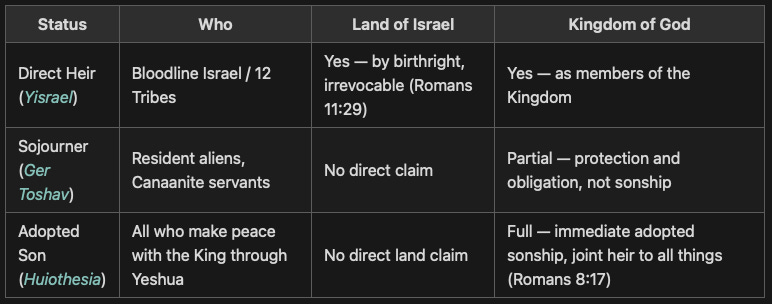
The adopted son does not inherit the land of Canaan. But this is not a diminishment. The Kingdom of God — which the adopted son inherits in full — encompasses all of creation, is eternal, has no geographic boundary, and carries the full weight of the Abrahamic promise that all the families of the earth will be blessed. The land is a portion of what the Kingdom contains. The heir of the Kingdom has received something far greater than the portion.
Ruth and Boaz: The Go’el as Living Type
The book of Ruth (Megillat Rut) is one of the most compact and precise illustrations of the entire grafting-in theology in scripture.
Ruth the Moabite is cut off by birth — a member of a people with a complicated and often adversarial history with Israel. Under the Mosaic law, Moabites were excluded from the assembly of Israel to the tenth generation (Deuteronomy 23:3). By birthright, she has no claim.
She grafts herself in by declaration — not by bloodline, not by generations of integration, but by a single covenant commitment: “Your people shall be my people, and your God, my God. Where you die, I will die, and there will I be buried.” (Ruth 1:16-17) She makes a covenant declaration, she acts on it faithfully, and she is received.
But notice what Ruth does not receive simply by her declaration: she does not inherit land. She and Naomi are landless — destitute, dependent on the charity of gleaning at the edges of fields. The land of the deceased husband’s family requires a go’el (גֹּאֵל — “kinsman-redeemer,” from ga’al, “to redeem, to reclaim, to buy back what was lost”).
Enter Boaz (Bo’az — “in him is strength”). He is the near kinsman. He chooses to redeem — to pay the price of the lost inheritance, to marry the widow, to restore the family name and the family land. The land comes back not through Ruth’s claim but through the redeemer’s action.
Boaz, the go’el who pays the price of redemption to restore the landless to their inheritance, is a type — a foreshadowing figure — of Yeshua himself, the ultimate Kinsman-Redeemer who pays the price that the lost could never pay for themselves. “In him is strength.”
And Ruth — the Moabite, the cut-off outsider, the one who had no right to the covenant by ancestry — ends up in the genealogy of David (Ruth 4:17) and of Yeshua himself (Matthew 1:5). The one who said “your God is my God” becomes an ancestor of the eternal King-Priest. The grafting-in trajectory, carried all the way to its conclusion, runs through the family line of the Messiah himself.
The adopted stranger becomes a mother of kings. That is what huiothesia looks like when it runs to its completion.
Part Eleven: The Third Temple — Physical Sign and Eschatological Marker
Two Temples, Two Covenant Tiers — Not in Conflict
The Living Temple described in Part Three — the Spirit dwelling in the hearts of believers, the corporate body of believers as a spiritual house built from living stones — belongs to the New Covenant tier, the huiothesia dimension. It is the fulfillment of Jeremiah 31 and Ezekiel 36: the Torah on hearts, God dwelling within his people.
The Third Temple belongs to a different covenant tier entirely — the specific, geographic, national promises made to the House of Israel through the Abrahamic and Davidic covenants. These two temples do not compete. They do not contradict each other. They operate at different levels of the same covenant structure, just as the land promise and the kingdom inheritance are both real and operate at different covenant levels without canceling each other.
The believer does not stop being a temple of the Holy Spirit when a physical temple is built in Jerusalem. The construction of the Third Temple does not replace, supersede, or contradict the Living Temple theology of Part Three. What the Third Temple marks is the approaching culmination of the promises specifically made to the House of Israel — the national, physical, political promises of the Abrahamic and Davidic covenants. It is the end of an age, an eschatological marker, a sign that the final resolution of all covenant promises is imminent.
The Third Temple Is Required by the Text
This is not speculation or theological preference. A physical Third Temple is required by the prophetic texts themselves:
Daniel 9:27 requires a functioning temple with active sacrifices before the “abomination of desolation”can occur: “He will put a stop to sacrifice and grain offering; and on the wing of abominations will come one who makes desolate.” For sacrifices to be stopped, they must first be running. A temple is required.
Yeshua himself confirms this is future in Matthew 24:15: “When you see the abomination of desolation which was spoken of through Daniel the prophet, standing in the holy place (hagios topos — the Temple precincts)...” He is speaking to his disciples approximately forty years before the destruction of the Second Temple, and he frames it as a future event requiring watchfulness. A holy place must exist and be operational for this to be fulfilled.
Paul in 2 Thessalonians 2:3-4 adds further specification: the man of lawlessness “takes his seat in the temple of God, displaying himself as being God.” This cannot be metaphorical — a person cannot sit in a metaphor. A physical structure is required.
These three witnesses — Daniel, Yeshua, and Paul — converge on the same conclusion: a physical Third Temple will be built, will be operational, and will be the location of a specific desecrating act that triggers the final sequence of eschatological events.
Gog, Magog, and the Prophetic Convergence
Ezekiel 38–39 describes the invasion of a restored Israel by a great northern coalition (Gog of the land of Magog) at a time when Israel dwells in apparent security (Ezekiel 38:8, 11). The coalition is destroyed by divine intervention so complete that it takes seven months to bury the dead and seven years to burn the weapons. The result is the full restoration of Israel to covenant relationship with Adonai: “I will not hide my face from them any longer, for I will have poured out my Spirit on the house of Israel.” (Ezekiel 39:29)
Revelation 20:7-10 uses the same names — Gog and Magog — for the final rebellion after the millennium, destroyed by fire from heaven. These may be two distinct events on either side of the millennium, or the same reality described from two prophetic vantage points separated by the distance of vision. What is clear in both is the outcome: the final, complete establishment of God’s sovereign rule, and both specifically involve the physical, national restoration of Israel to her covenant promises.
Daniel’s contribution — the seventy weeks (Daniel 9:24-27), the abomination of desolation, the time of distress unlike any other (Daniel 12:1) — provides the timeline scaffolding on which the Third Temple events are positioned. Yeshua’s references to Daniel in the Olivet Discourse (Matthew 24) make clear that the fulfillment is still future from his own first-century vantage point — meaning the events were not fully accomplished in 70 AD, whatever partial fulfillment may have occurred at that time.
The Final Sequence
The Third Temple, once built, will follow the same pattern as the Tabernacle and Solomon’s Temple before it: it will serve its purpose as a model, a working instrument of covenant fulfillment, and then give way to what it was always pointing toward. When the King returns to reign in person — when the New Jerusalem descends (Revelation 21) — there is no temple in it, “for the Lord God the Almighty and the Lamb are its temple.” (Revelation 21:22)
The Third Temple will have served its purpose as the final physical sign of the approaching end of the age, the fulfillment of the national covenant promises to the House of Israel, and the stage on which the last sequence of events before the King’s return will play out. And then the model, as all the models before it, will give way to the reality it was always representing.
This is the fulfillment of the promises to the House of Israel — not their cancellation, not their spiritualization, not their transfer to anyone else. God said what he meant. He meant what he said. And he keeps his word.
Part Twelve: The Authority of the Apostolic Witness
The Charge Against Paul
The most persistent attack against the New Testament from those seeking to discredit it is the claim that Paul of Tarsus (Sha’ul HaTarsi) was a false prophet — that he invented a new religion, contradicted the Torah, and cannot be trusted. This charge deserves a direct answer, because it is both historically uninformed and internally inconsistent with the evidence.
The Evidence of Luke
Luke (Loukas) wrote two documents forming the longest single contribution to the New Testament: the Gospel of Luke and the Acts of the Apostles. Both are addressed to Theophilus and describe careful historical investigation (Luke 1:1-4): “It seemed fitting for me as well, having investigated everything carefully from the beginning, to write it out for you in consecutive order.”
Luke was not a distant admirer of Paul. He was his traveling companion. Paul identifies him directly — “Luke, the beloved physician” (Colossians 4:14), “Luke alone is with me” (2 Timothy 4:11), and as a “fellow worker” (Philemon 24). The “we passages” in Acts (16:10-17; 20:5–21:18; 27:1–28:16) — where the narrative shifts from “they” to “we” — indicate Luke was an eyewitness to events in Paul’s ministry. His account of Paul is the account of an eyewitness companion, written as careful historical record.
The Testimony of Peter
Simon Peter (Shim’on Kefa) — who walked with Yeshua from the beginning, who was present at the Transfiguration and the resurrection appearances, whom Yeshua named as the rock on which the community would be built — writes in his second letter:
“Regard the patience of our Lord as salvation; just as also our beloved brother Paul, according to the wisdom given him, wrote to you, as also in all his letters, speaking in them of these things, in which are some things hard to understand, which the untaught and unstable distort, as they do also the rest of the Scriptures.” (2 Peter 3:15-16)
Peter calls Paul’s letters graphas — the same Greek word used for the scriptures of the Tanakh. A man who walked with Yeshua personally places Paul’s writings in the category of Scripture. If Paul was a false prophet, Peter had every reason and ability to say so. He said the opposite.
The Jerusalem Council of Acts 15 — attended by Peter, James (Ya’akov), and the full apostolic leadership — validated Paul’s mission and found no contradiction between his message and the apostolic tradition. Galatians 1–2 records that Peter and James recognized the grace given to Paul and extended the right hand of fellowship (Galatians 2:9). The charge that Paul operated independently of the apostolic community is directly contradicted by the apostles themselves.
Historical Sources Outside the New Testament
Clement of Rome (~96 AD): Bishop of Rome, possibly personally acquainted with both Peter and Paul. His letter 1 Clement — written within one generation of the apostles — treats Paul’s authority as established and unquestioned.
Ignatius of Antioch (~107 AD): Writing on his way to martyrdom, Ignatius references Paul extensively and treats his letters as authoritative instruction for the believing community.
Polycarp of Smyrna (~155 AD): A personal student of the Apostle John, Polycarp’s Letter to the Philippians references Paul’s letters as authoritative scripture within living memory of the apostles.
Tacitus (Annals, ~116 AD): The Roman historian — no friend of Christians — confirms the execution of Yeshua under Pontius Pilate. An external, non-sympathetic source confirming the core historical claim at the foundation of this document.
Josephus (Antiquities of the Jews, ~93 AD): References Yeshua and James “the brother of Yeshua who was called Messiah” (Antiquities 20.9.1), an independent Jewish historical confirmation of the central figures of the New Testament.
The charge that Paul invented a new religion is contradicted by his traveling companion Luke, by the Apostle Peter, by the Jerusalem apostolic leadership, and by a chain of early witnesses whose testimony reaches to within living memory of the events themselves.
Part Thirteen: Prophecies Fulfilled — The Evidentiary Record
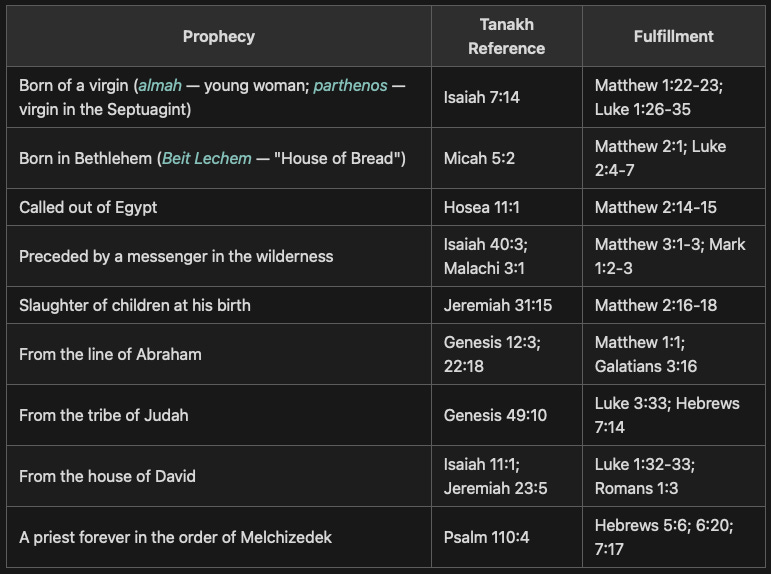
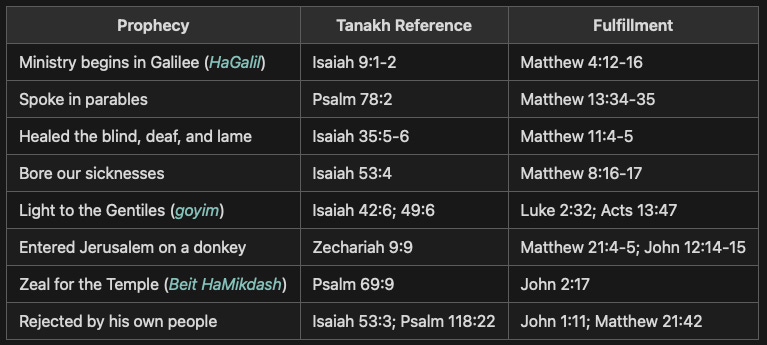
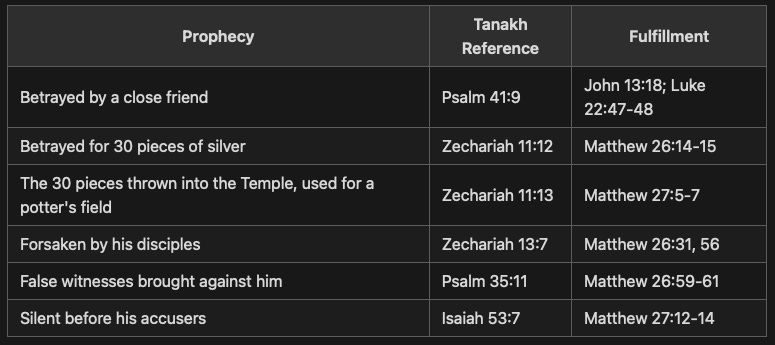
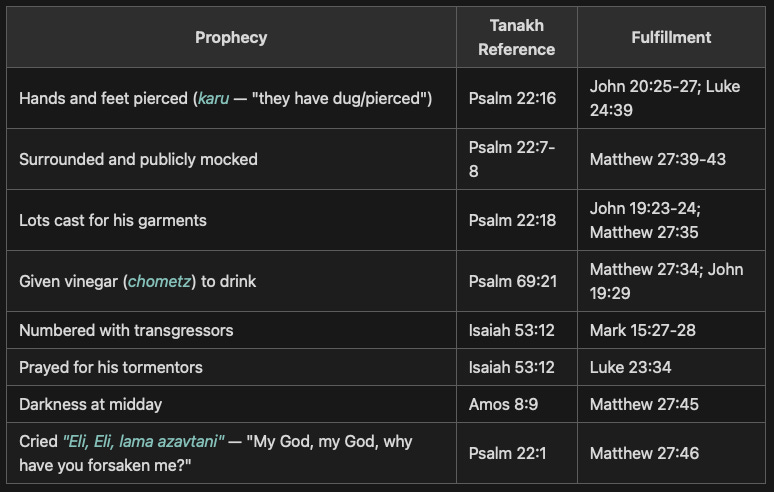
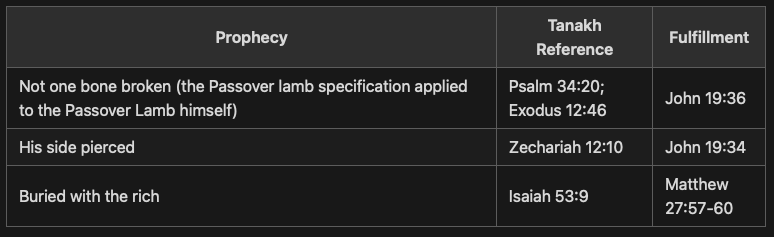
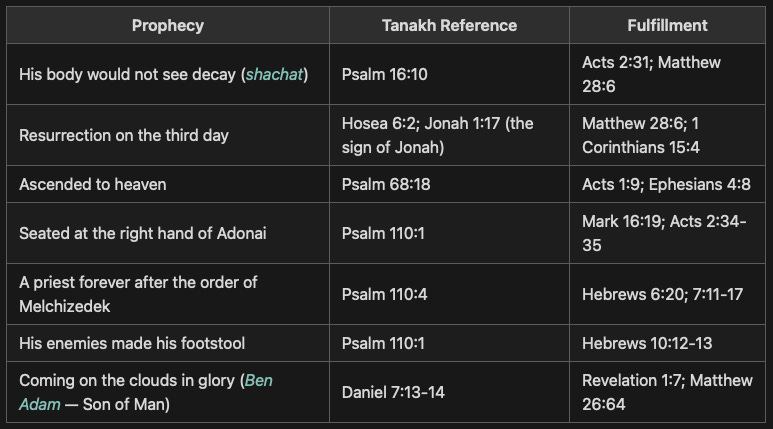
One of the most powerful evidences for the identity of Yeshua as the promised Messiah is the convergence of specific prophecies made centuries before his birth — in historical circumstances he did not control, involving details no individual could arrange for himself.
A note on probability: The probability of any individual fulfilling even eight of the prophecies below by chance has been calculated at approximately 1 in 10 to the 17th power. The list below contains far more than eight.
His Birth and Origins
His Ministry
His Betrayal and Trial
His Crucifixion
His Death and Burial
His Resurrection and Exaltation
Part Fourteen: The Identity That Results
All of this — the six covenants, the Melchizedek thread, the Living Temple, the Torah’s three roles, the cross, the servant, the craftsman, the prophetic witnesses, the three covenant tiers, the Third Temple, the apostolic record, and the prophetic fulfillments — exists not as abstract theology but as the foundation of a living, unassailable identity.
The covenant is sealed. The sacrifice is complete. The eternal King-Priest lives and intercedes without interruption. The Temple is no longer a building behind a veil — it is the heart of every believer who has made peace with the King. The Torah has been fulfilled in the one person it was designed to protect, to expose, and to point toward. And the adopted sons and daughters of God hold full sonship rights — not by bloodline, not by generations of earning, but by the immediate, irrevocable act of huiothesia, sealed by the Holy Spirit himself.
Because of what Yeshua accomplished, those who are in him possess a position that no argument can overturn, no accusation can void, and no failure can permanently forfeit:
Peace with God — not a temporary armistice but a permanent reconciliation secured by the blood of the covenant (Romans 5:1)
Dead to sin and alive to God — a change of legal and spiritual status, not merely a moral aspiration (Romans 6:11)
No condemnation — the verdict is in, rendered by the only judge whose ruling stands (Romans 8:1)
Joint heirs with Yeshua — co-inheritors, not beneficiaries, of the Kingdom (Romans 8:17)
More than conquerors (hypernikomen — “to overwhelmingly prevail”) through him who loved us (Romans 8:37)
God’s own handiwork (poiema — “craftsmanship,” from which we get the English word “poem”) — created in Yeshua upon prepared works (Ephesians 2:10)
Fellow citizens with the saints — full standing in the household of God (Ephesians 2:19)
A royal priesthood and holy nation (mamlekhet kohanim v’goy kadosh) — the very language Adonai used for Israel at Sinai, now extended through Yeshua to all who are in him (1 Peter 2:9)
Completely complete in Yeshua (pepleroomenoi en auto — “filled to fullness in him,” Colossians 2:10)
This is covenant language — the language of a document sealed by the blood of the eternal King-Priest who holds all authority in heaven and on earth, who lives forever to make intercession, and whose covenant cannot be broken because he himself cannot die again.
The basis of this identity is not our performance. It is his accomplishment. And it has been building, covenant by covenant, from the breath of life in Genesis to the empty tomb outside Jerusalem — one unbroken thread, woven by the same hand from the beginning, arriving at exactly the destination it was always heading toward.
Appendix: My Identity in Christ — A Companion Document
The declarations above are expanded in full in the companion document My Identity in Christ — Expanded, which compiles the specific scriptural basis for each aspect of the believer’s position in Yeshua HaMashiach. That document includes the full text of Romans 5:1-21 (the results of justification) and Romans 6:1-14 (what it means to be dead to sin), followed by a comprehensive list of identity declarations each grounded in specific scripture.
Selected highlights:
“I am a child of God” — Romans 8:16; 1 John 3:1-2; Galatians 3:26
“I am forgiven of all my sins” — Romans 4:7
“I am delivered from the power of darkness and translated into the kingdom of God’s dear Son” — Colossians 1:13
“I am more than a conqueror through him that loved me” — Romans 8:37
“I have been crucified with Yeshua and I no longer live, but Yeshua lives in me” — Galatians 2:20
“God who began a good work in me will carry it on to completion until the day of Yeshua” — Philippians 1:6
“I am a member of a chosen race, a kingly priesthood, a holy nation, a people for God’s own possession” — 1 Peter 2:9
This companion document should be read alongside this thesis as its practical application — what the six covenants accomplish, what the eternal King-Priest secured, specifically and personally, for all who are in him.
Part Fifteen: Ezekiel’s Temple — Where the Threads Converge
The Vision and Its Context
In 573 BC — approximately fourteen years after Jerusalem fell and Ezekiel’s fellow exiles were scattered in Babylon — the prophet is taken in a vision to the land of Israel and shown something extraordinary: a detailed architectural blueprint of a future Temple, with measurements so precise (given in cubits, hand breadths, and specific proportions) that architects have produced scaled drawings from the text. This is not poetry. This is not metaphor. This is the specification sheet of a builder who knows exactly what he intends to construct.
The vision occupies nine full chapters (Ezekiel 40–48) and covers the Temple’s outer courts, inner courts, gates, chambers, the sanctuary itself, the altar, the priests’ roles, the land allotment around the Temple, and — most significantly — a river.
Three things about Ezekiel’s Temple connect directly to everything this document has established: the return of the glory, the restoration of the priesthood, and the river that brings life wherever it flows.
The Glory Returns — From the East
The single most theologically charged moment in the entire vision comes in Ezekiel 43:1-5:
“Then he led me to the gate, the gate facing east; and behold, the glory of the God of Israel was coming from the way of the east. And His voice was like the sound of many waters; and the earth shone with His glory... and behold, the glory of the LORD filled the house.”
This is the kavod Adonai — the same glory that departed in Ezekiel 10–11, moving east over the Mount of Olives in one of the most haunting scenes in the Tanakh. Now it returns. And it returns from the same direction it departed: from the east, over the Mount of Olives.
This is not incidental geography. Yeshua ascended from the Mount of Olives (Acts 1:9-12). Zechariah 14:4 declares that when he returns, “his feet will stand on the Mount of Olives, which is in front of Jerusalem on the east.” The departure of the glory, the ascension of Yeshua, and the return of the glory all share the same geographical point. The thread is deliberate and precise.
Adonai’s word to Ezekiel upon the glory’s return is equally precise: “Son of man, this is the place of my throne and the place of the soles of my feet, where I will dwell among the sons of Israel forever.” (Ezekiel 43:7) This is the same shakan language — dwelling, taking up permanent residence — that runs through the entire Temple progression of Part Three. The physical Third Temple is the appointed location where the returning King-Priest will take up his throne.
The Zadokite Priesthood: Faithfulness Rewarded
Ezekiel 44:15 specifies which priestly line will serve in this Temple: “But the Levitical priests, the sons of Zadok, who kept charge of my sanctuary when the sons of Israel went astray from me, shall come near to me to minister to me; and they shall stand before me to offer me the fat and the blood.”
Zadok (Tzadok — “righteous”) was the faithful high priest under David and Solomon — the priest who remained loyal when Abiathar sided with Adonijah’s attempted coup and was subsequently removed by Solomon (1 Kings 2:26-27, 35). The sons of Zadok are those whose faithfulness to Adonai was maintained when those around them compromised. In the Millennial Temple, they are restored to service as a direct consequence of that faithfulness.
This is a specific, historical, identifiable priestly line — not a metaphor for generic spiritual service. The precision of the promise points to literal fulfillment. The Zadokite priesthood in Ezekiel’s Temple is one of the clearest markers that the vision describes a physical, historical event in which Adonai honors the specific faithfulness of a specific people.
The River: Life From the Threshold
Ezekiel 47:1-12 describes what flows from beneath the threshold of the Temple:
“Then he brought me back to the door of the house; and behold, water was flowing from under the threshold of the house toward the east... He measured a thousand cubits and led me through the water — water reaching the ankles. Again he measured a thousand and led me through the water — water reaching the knees. Again he measured a thousand and led me through — water reaching the loins. Again he measured a thousand; and it was a river that I could not ford, for the water had risen, enough water to swim in, a river that could not be forded.”
The river begins as a trickle at the Temple threshold and grows — without any tributaries joining it — into a river too deep to cross. It flows east, toward the Dead Sea (Yam HaMelach — “the Sea of Salt”), and wherever it goes: “everything will live where the river goes.” (Ezekiel 47:9) The Dead Sea — one of the most lifeless bodies of water on earth — becomes fresh, teaming with fish. Trees line both banks, bearing fruit every month, their leaves for healing.
This river sits at the intersection of three threads that run through the entire Bible:
Genesis 2:10 — “Now a river flowed out of Eden to water the garden.” The river of Eden watered the first garden. Ezekiel’s river waters the restored earth. What was lost at the fall is restored at the return of the King.
Zechariah 14:8 — In the same passage that describes Yeshua’s feet standing on the Mount of Olives, Zechariah adds: “And in that day living waters will flow out of Jerusalem, half of them toward the eastern sea and the other half toward the western sea.” The geography matches Ezekiel’s vision precisely.
John 7:37-39 — At the Sukkot feast (the Feast of Tabernacles, the feast that looks forward to God dwelling among his people), Yeshua stands and cries out: “If anyone is thirsty, let him come to me and drink. He who believes in me, as the Scripture said, ‘From his innermost being will flow rivers of living water.’” John clarifies: “But this he spoke of the Spirit, whom those who believed in him were to receive.”
Revelation 22:1-2 — “Then he showed me a river of the water of life, clear as crystal, coming from the throne of God and of the Lamb, in the middle of its street. On either side of the river was the tree of life, bearing twelve kinds of fruit, yielding its fruit every month; and the leaves of the tree were for the healing of the nations.”
The river flows from Eden, through Ezekiel’s Temple, through the believer’s innermost being by the Spirit, and out of the throne of God and the Lamb in the New Jerusalem. It is the same river at different stages of the same story — the life of God flowing outward from his presence, growing deeper and wider as the story reaches its conclusion.
Where the Threads Meet
Ezekiel’s Temple is the physical and historical convergence point of everything this document has traced:
The Shekinah glory that departed in Ezekiel 10 returns in Ezekiel 43 — from the east, over the Mount of Olives, to its permanent throne
The Zadokite priesthood is restored — specific, historical, faithful, rewarded
The river flows from the threshold of the Temple — beginning as a trickle and growing into a life-giving flood that heals even the Dead Sea
And all of it sits in the exact location where the eternal King-Priest will return and reign: the city of Jerusalem, the Mount of Olives, the Temple Mount. Not metaphorically. Not spiritually only. Physically, historically, and permanently.
The Third Temple is where the Living Temple and the physical promises converge. The Spirit that dwells within believers is the firstfruits — the bikkurim — of the river that will one day flow from the throne of the returning King. Both are real. Both are the same source. The trickle beneath the threshold of Ezekiel’s Temple and the rivers of living water flowing from the innermost being of the believer are two expressions of the same life, at two different stages of the same story.
Part Sixteen: Answering the Counter-Missionary Arguments
A Word on Approach
The arguments addressed in this section are raised by those who actively work to dissuade Jewish people from recognizing Yeshua as the Messiah, and by others who draw on those arguments to challenge the credibility of the New Testament. The arguments deserve honest, direct, and precise responses — not because every hardened heart will be moved (Part Nine addressed that reality), but because the arguments themselves are answerable on the Tanakh’s own terms, and believers and apologists should be equipped to answer them.
Each argument below is stated in its strongest form before being answered.
Argument 1: The Messiah Was Supposed to Accomplish Specific Things — Yeshua Did None of Them
The Argument: According to Maimonides (Rambam) and the rabbinic tradition, the Messiah must accomplish specific tasks during his lifetime: rebuild the Temple in Jerusalem, gather all Jews to Israel, usher in an era of universal peace, and bring all nations to acknowledge the God of Israel. Yeshua did none of these things. He was executed by Rome, the Temple was destroyed forty years after his death, and the world did not experience peace. Therefore he cannot be the Messiah.
The Response: This argument assumes that the Messiah comes once and accomplishes everything in a single appearance. But the Tanakh itself presents two irreconcilably different portraits of the Messiah that cannot be fulfilled in the same event:
Portrait One — The Suffering Servant:
“He was despised and forsaken of men, a man of sorrows and acquainted with grief.” (Isaiah 53:3)
“He was cut off out of the land of the living for the transgression of my people.” (Isaiah 53:8)
“They will look on me whom they have pierced; and they will mourn for him.” (Zechariah 12:10)
“Rejoice greatly, O daughter of Zion... Behold, your king is coming to you; he is just and endowed with salvation, humble, and mounted on a donkey.” (Zechariah 9:9)
Portrait Two — The Conquering King:
“Of the increase of his government and peace there will be no end.” (Isaiah 9:7)
“He will judge between the nations and will render decisions for many peoples; and they will hammer their swords into plowshares.” (Isaiah 2:4)
“In that day the nations will resort to the root of Jesse, who will stand as a signal for the peoples; and his resting place will be glorious.” (Isaiah 11:10)
“The LORD will be king over all the earth; in that day the LORD will be the only one, and his name the only one.” (Zechariah 14:9)
These two portraits cannot describe the same person in the same event. A man who is despised, rejected, pierced, and cut off from the land of the living is not simultaneously ushering in universal peace and ruling over all nations. The ancient rabbis recognized this tension — some resolved it by positing two separate Messianic figures: Mashiach ben Yosef (who suffers and dies) and Mashiach ben David (who conquers and reigns).
The New Testament presents a simpler and more coherent resolution: one person, two comings, separated by time. The first coming fulfilled every aspect of the suffering servant portrait — to the detail of the price of betrayal, the casting of lots, the pierced hands and feet, and the burial with the rich. The second coming will fulfill every aspect of the conquering king portrait — the universal reign, the permanent peace, the restoration of Israel, the gathering of the nations.
To demand that the Messiah accomplish both portraits in a single appearance is to impose on the Tanakh a condition the Tanakh itself never states — and to ignore the internal tension within the prophetic texts that the two-coming framework resolves.
Argument 2: Judaism Is Strictly Monotheistic — God Cannot Become a Man or Have a Son
The Argument: The Torah declares unequivocally: “Hear, O Israel: The LORD our God, the LORD is One.”(Shema Yisrael, Adonai Eloheinu, Adonai Echad — Deuteronomy 6:4) The idea that God became a man, or that God has a literal Son, is a pagan concept borrowed from Greek and Roman religion. It contradicts the foundational monotheism of the Torah.
The Response: The monotheism of the Torah is correct and non-negotiable — the New Covenant does not abandon it. But the Tanakh itself contains passages that require a complexity within the one God that the purely unitarian reading cannot accommodate:
The Angel of the LORD (Malakh Adonai): Multiple times in the Tanakh, the Malakh Adonai appears as a distinct figure who is simultaneously identified as Adonai himself:
Genesis 16:13 — Hagar “called the name of the LORD who spoke to her, ‘You are a God who sees.’”She speaks to the Angel as God.
Exodus 3:2-6 — The Angel of the LORD appears in the burning bush, and then the text says: “God called to him from the midst of the bush.” The Angel and God are identified as the same presence.
Judges 13:22 — Manoah declares: “We will surely die, for we have seen God” — after seeing the Angel of the LORD.
The Angel of the LORD is not a created being. He is identified with God, receives worship that God elsewhere prohibits giving to any creature, and speaks as God in the first person. The Tanakh requires an agent of God who is fully God — distinct in appearance and action, unified in being.
Isaiah 9:6 assigns to the coming child names that are unambiguously divine:
El Gibbor — Mighty God (not “a mighty one” or “a godlike being” — the same title given to Adonai himself in Isaiah 10:21)
Avi Ad — Father of Eternity, Everlasting Father
A human being, however exalted, is not called El Gibbor in the Tanakh. This child is divine.
Proverbs 8 and the personification of Wisdom (Chokhmah): Wisdom speaks in the first person, describes herself as present at creation, delighting before the LORD, and as the craftsman through whom creation was made (Proverbs 8:22-31). The Davar Adonai — the Word of the LORD — is similarly presented as the agent of creation in Psalm 33:6: “By the word of the LORD the heavens were made.”
The Tanakh presents a God who is one — echad — but echad in Hebrew does not mean solitary. The same word is used in Genesis 2:24 where a man and a woman become “one flesh” — a unity of distinct persons. The one God of Israel contains within his unity a complexity that the Tanakh itself points to, and that the New Covenant reveals more fully.
The New Covenant is not importing Greek paganism. It is drawing out what was always implicit in the Angel of the LORD, in Isaiah’s divine child, in the personified Wisdom of Proverbs, and in the Word through whom creation came to be.
Argument 3: Paul Abolished the Torah — This Contradicts God Who Said It Is Eternal
The Argument: Deuteronomy 13:1-5 warns against a prophet who leads Israel to abandon the Torah. Paul teaches that believers are “not under the Law” (Romans 6:14, Galatians 5:18) and that Torah observance is unnecessary for salvation. This makes Paul a false prophet by the Torah’s own standard, and disqualifies Yeshua whose teaching Paul represents.
The Response: This argument rests on a misreading of Paul that the text of Romans does not support. Paul’s statement that believers are “not under the Law” does not mean the Torah is invalid or abandoned. It means something far more precise: believers are not under the condemnation of the Law — the legal penalty the Law pronounces on those who fail to keep it — because Yeshua absorbed that condemnation completely. (Romans 8:1-4)
Several points close this argument:
Paul himself observed Torah. Acts 21:24-26 records Paul undergoing purification rites in the Temple. Acts 18:18 records him taking a Nazirite vow. He did not teach Jewish believers to abandon Torah observance — he taught that Torah observance is not the mechanism of salvation, which is a position fully supported by the Tanakh itself. Abraham was justified by faith before circumcision and before the Torah was given (Romans 4, citing Genesis 15:6). If Torah observance had always been the mechanism, Abraham would not qualify.
Yeshua himself said the same. Matthew 5:17-18: “Do not think that I came to abolish the Law or the Prophets; I did not come to abolish but to fulfill. For truly I say to you, until heaven and earth pass away, not the smallest letter or stroke shall pass from the Law.” Yeshua affirmed the Torah’s permanent validity.
The New Covenant relocates Torah, not abolishes it. Jeremiah 31:33: “I will put my law within them and on their heart I will write it.” Ezekiel 36:27: “I will cause you to walk in my statutes.” The New Covenant does not remove the Torah. It moves the Torah from stone tablets to human hearts — powered not by human effort but by the indwelling Spirit. This is more than external observance, not less.
The three roles of Torah (Part Four) clarify the framework: the Torah protected the messianic lineage until Yeshua’s arrival, proved that human flesh cannot achieve divine righteousness, and demonstrated the irrevocable character of God’s promises. Each of these roles is completed in Yeshua — not abandoned. A completed role is not an abolished law. It is a fulfilled purpose.
Deuteronomy 13 warns against a prophet who leads Israel to abandon Adonai and follow other gods. Paul consistently directs his readers toward the God of Abraham, Isaac, and Jacob — the God of the Tanakh — and grounds every argument he makes in the Tanakh’s own texts. He does not lead away from Adonai. He leads toward him, through the one the Tanakh’s own prophets announced.
Argument 4: Yeshua’s Davidic Lineage Cannot Be Established
The Argument: The Messiah must be descended from David through the male line. But Yeshua had no biological father — Joseph was not his biological parent. Therefore the Davidic lineage through Joseph is legally irrelevant. Furthermore, the Temple records that would have verified genealogical claims were destroyed in 70 AD, making any claim to Davidic descent unverifiable.
The Response: This argument contains two claims, both of which are answerable.
On the genealogy records: The genealogies in Matthew 1 and Luke 3 were written and in circulation before the destruction of Jerusalem in 70 AD. Matthew’s gospel is commonly dated to the 50s-60s AD; Luke’s to approximately 60-62 AD. Both were written while eyewitnesses were alive and genealogical records were accessible for verification. The genealogies were not written to fill a vacuum after records were lost — they were written when the records existed and could be checked. The destruction of 70 AD cannot retroactively invalidate documentation that predates it.
On the Joseph question: The argument assumes that a purely biological paternal line is required — but the Torah itself establishes that adoption confers full legal standing. Huiothesia — legal adoption — was a recognized mechanism throughout the ancient world, including within the Hebraic framework. When Joseph accepted Yeshua as his son and gave him his name, he conferred full legal standing in the Davidic line. The throne rights of David — which is what the Messianic kingship requires — pass through legal standing, not only biology.
This is not a convenient dodge. It is the same principle by which every king of Judah who was not the biological son of the previous king but was legally designated as heir held legitimate claim to the throne.
Two complementary genealogies: Matthew traces the legal royal line through Joseph — through Solomon, establishing the right to the Davidic throne. Luke traces the biological line through Mary — through Nathan, a different son of David, establishing the bloodline without the legal complications of the Jeconiah curse (Jeremiah 22:30, which declared that no descendant of Jeconiah would sit on the throne — a curse that applies to Joseph’s line but not to Mary’s, since she descends through Nathan rather than Solomon).
The two genealogies are not contradictory. They are complementary — one establishing legal throne rights, the other establishing biological Davidic descent through an uncursed line. Together they close every avenue of objection: Yeshua has both the legal right to the throne and the biological descent from David through a line the Jeconiah curse does not reach.
The virgin birth enables, not undermines, the messianic credentials. The sin nature passed through the Adamic line required a break in that transmission for a sinless offering to be possible. The virgin birth is not a theological liability — it is a biological necessity for the fulfillment of the sacrificial requirement. The sinless life required a sinless origin.
Argument 5: The Name “Jesus” Is a Pagan Corruption — The True Messiah’s Name Was Never “Jesus”
The Argument: The name “Jesus” does not appear in the Hebrew scriptures. It is a Greek/Latin corruption that severs the Messiah from his Hebrew identity. Some go further and claim the name has pagan etymological roots, making its use spiritually problematic.
The Response: This argument rests on a misunderstanding of how names travel across languages and is historically unsupportable.
The progression is straightforward:
Yeshua (יֵשׁוּעַ — Hebrew/Aramaic) → Iesous (Ἰησοῦς — Greek transliteration) → Iesus (Latin) → Jesus(English)
Each step is a phonetic transliteration — the sounds of the name carried into a new alphabet — not a translation of meaning or a substitution of identity. This is how names always travel across languages. The Hebrew Yehoshua (Joshua) becomes Iesous in the Greek Septuagint (the ancient Jewish translation of the Hebrew scriptures into Greek) — the same Greek word used for Yeshua in the New Testament. When the author of Hebrews 4:8 refers to Joshua (Yehoshua) leading Israel into the Promised Land, the Greek text uses Iesous. The claim that Iesous is a pagan corruption would require the ancient Jewish translators of the Septuagint to have been the originators of the corruption — an unsupportable position.
The name Yeshua means “Adonai saves” or “Adonai is salvation” — from the root yasha (יָשַׁע), “to save, to deliver.” Matthew 1:21 makes this explicit: “You shall call his name Yeshua, for he will save (yasha) his people from their sins.” The name carries its full Hebrew meaning into every language into which it is transliterated. The sound changes. The identity does not.
The Pastoral Conclusion
These arguments have been presented in their strongest form and answered on the Tanakh’s own terms — using the same texts, the same covenant framework, and the same logical tools that the arguments themselves employ. The evidence is substantial. The case is coherent. The convergence of genealogy, prophecy, covenant structure, and historical record points consistently and specifically to Yeshua HaMashiach.
But as Part Nine established: the apologist’s responsibility is to make the argument faithfully and precisely. The outcome belongs to God. Some hearts will remain hardened — not because the evidence is insufficient, but because hardness of heart is not an intellectual condition. It is a spiritual one, and only the intervention of the Spirit of God produces genuine, lasting persuasion.
We present the evidence. We pray for the opening of eyes. And we remember that Paul himself — the most prolific defender of the gospel in the New Testament, the man whose legal brief in Romans is the backbone of this entire document — was a persecutor of the assembly of Yeshua until the moment the risen Messiah appeared to him on the road to Damascus. The hardest hearts are not beyond reach. They are simply beyond argument alone.
Appendix: My Identity in Christ — A Companion Document
The declarations above are expanded in full in the companion document My Identity in Christ — Expanded, which compiles the specific scriptural basis for each aspect of the believer’s position in Yeshua HaMashiach. That document includes the full text of Romans 5:1-21 (the results of justification) and Romans 6:1-14 (what it means to be dead to sin), followed by a comprehensive list of identity declarations each grounded in specific scripture.
Selected highlights:
“I am a child of God” — Romans 8:16; 1 John 3:1-2; Galatians 3:26
“I am forgiven of all my sins” — Romans 4:7
“I am delivered from the power of darkness and translated into the kingdom of God’s dear Son” — Colossians 1:13
“I am more than a conqueror through him that loved me” — Romans 8:37
“I have been crucified with Yeshua and I no longer live, but Yeshua lives in me” — Galatians 2:20
“God who began a good work in me will carry it on to completion until the day of Yeshua” — Philippians 1:6
“I am a member of a chosen race, a kingly priesthood, a holy nation, a people for God’s own possession” — 1 Peter 2:9
This companion document should be read alongside this thesis as its practical application — what the six covenants accomplish, what the eternal King-Priest secured, specifically and personally, for all who are in him.
Closing: A Note on the Completion of This Document
This document began as a series of theological reflections and has grown into a working thesis tracing the unbroken covenant thread from Genesis to Resurrection. Every major question raised in the course of its development has been addressed:
The six covenants and their top-down, God-initiated pattern
The Melchizedek thread that resolves the legal tension between the royal and priestly offices
The Living Temple progression from the Tabernacle to the human heart
The Torah’s three roles that make Yeshua the resolution, not the revision
The cross as both substitutionary atonement and establishment of unassailable authority
The servant who came to give life to what cannot give life to itself
The craftsman who returns to make all things right
The prophets as legal witnesses whose deaths were advance testimony
The prophetic corpus as a unified legal brief, already argued by Paul in Romans and Hebrews
Isaiah 53 and Daniel 7 answered on their own textual terms
The three covenant tiers — direct heir, sojourner, and adopted son — and the land question resolved
Ruth and Boaz as the living type of grafting-in through the kinsman-redeemer
The Third Temple as a physical eschatological marker, distinct from and not competing with the Living Temple
Ezekiel’s Temple as the convergence point of the river of life, the returning glory, and the restored priesthood
The authority of the apostolic witness defended against the charge of false prophecy
Forty-plus specific prophecies fulfilled with dual scriptural references
The five major counter-missionary arguments answered on the Tanakh’s own terms
The identity that results from all of it — unassailable, covenant-sealed, and personally applicable
Two companion documents are designed to be read alongside this thesis: My Identity in Christ — Expanded. Link: brianprogrammer.substack.com/p/my-identity-in-christ-expanded.
This document is a working draft toward a full theological thesis. Scripture quotations are drawn primarily from the NASB and ESV. Hebrew and Greek terms are included throughout and are always accompanied by plain English explanations.